How the Railroad Changed Everything
The Iron Tracks That Connected Carlsbad to the World
Opening Scene
Imagine standing here in Carlsbad Village in the late 1880s.
There are no freeways.
No Interstate 5.
No traffic lights.
No airport.
No cars lined up along Carlsbad Boulevard.
Instead, the loudest sound you hear is the whistle of a steam locomotive echoing across the coastal hills.
For the people who lived here, that whistle meant opportunity.
It meant visitors.
It meant new neighbors.
It meant fresh ideas.
It meant Carlsbad was no longer an isolated coastal settlement.
It had become connected to the world.
Before the Railroad
Before the railroad arrived, traveling to Carlsbad was slow and often difficult.
Stagecoaches and horse-drawn wagons carried passengers and supplies over rough dirt roads that could become nearly impassable after heavy rains.
Farmers worked hard to grow crops, but transporting fresh produce to larger markets was both time-consuming and expensive.
Even though Captain John Frazier’s mineral spring had begun attracting attention, few people had an easy way to visit.
Carlsbad had tremendous potential.
It simply needed a connection.
The Arrival of the Railroad
Everything changed in 1887 when the Atchison, Topeka & Santa Fe Railway extended its line through Carlsbad.
Almost overnight, the small coastal settlement became part of one of the nation’s most important transportation networks.
Visitors could now travel comfortably from Los Angeles and San Diego.
Businesses gained access to new customers.
Families found it easier to settle here.
The railroad became the lifeline that connected Carlsbad to the rest of California.
A Boost for Agriculture
The railroad didn’t just carry passengers.
It carried possibility.
Carlsbad’s farmers could now ship avocados, citrus, strawberries, vegetables, and eventually the colorful flowers that would make the city famous.
Fresh produce reached markets throughout Southern California and beyond.
Agriculture flourished.
The success of local farms helped create jobs, attract new residents, and strengthen the local economy.
Without the railroad, much of Carlsbad’s agricultural success might never have been possible.
Bringing Visitors to the Mineral Spring
The railroad also introduced thousands of people to Carlsbad’s greatest attraction at the time—its famous mineral water.
Travelers seeking health and relaxation could step off the train and experience the same healing waters that inspired the city’s name.
Hotels welcomed guests.
Bathhouses offered mineral soaks.
Local businesses flourished.
Carlsbad’s reputation as a wellness destination continued to grow.
Building a Village
As more people arrived, homes, businesses, churches, schools, and hotels followed.
The railroad encouraged investment.
It supported tourism.
It attracted entrepreneurs willing to build something new.
The quiet settlement envisioned by Gerhard Schutte and his partners gradually evolved into a vibrant seaside village.
Many of the streets we walk today owe their existence, at least in part, to the opportunities created by the railroad.
The Historic Depot
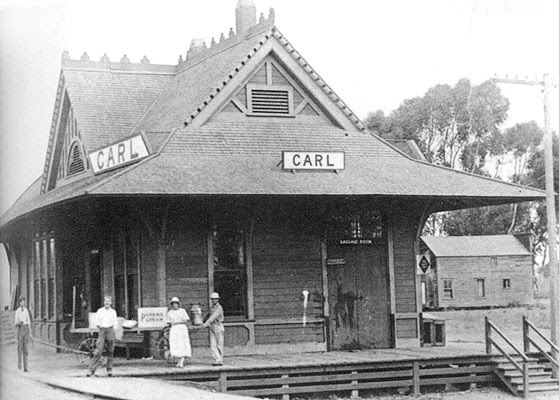
In 1887, Carlsbad’s Victorian railroad depot welcomed travelers arriving from near and far.
Today, it remains one of California’s oldest surviving railroad stations and serves as the Carlsbad Visitor Center.
Standing inside the depot, it’s easy to imagine families stepping off the train with suitcases in hand, eager to discover this peaceful coastal town.
The building is more than a landmark.
It’s a symbol of the moment Carlsbad opened its doors to the world.
More Than Transportation
The railroad did far more than move people and freight.
It connected dreams.
It allowed ideas to travel.
It brought cultures together.
It introduced visitors to Carlsbad’s hospitality and gave local residents new opportunities they had never imagined.
Every whistle that echoed through town announced another chance for Carlsbad to grow.
Why This Story Matters
The railroad didn’t create Carlsbad.
The mineral spring had already given the town its identity.
But the railroad gave Carlsbad momentum.
It connected a remarkable little community to California and beyond.
Many of the businesses, neighborhoods, and traditions we enjoy today trace their roots back to those first trains that rolled into town.
Continue the Story
To learn more about Carlsbad’s early years, continue with:
- The Historic Railroad Depot
- The Twin Inns
- Gerhard Schutte
- D.D. Wadsworth
- The Carlsbad Land & Mineral Water Company
- Historic Highway 101
Cherimarie’s Reflection
Whenever I hear a train passing through Carlsbad Village, I can’t help but think about the excitement those first locomotives must have brought to this community.
For the early residents, that sound represented hope.
It meant their little town was growing.
Their farms could reach new markets.
Visitors could experience the famous mineral water.
Families could build new lives here.
Today, the trains still roll through Carlsbad, carrying commuters, travelers, and visitors along the same coastline.
The technology has changed, but the feeling remains the same.
Every train reminds us that Carlsbad has always been a place where journeys begin.
And perhaps that’s why I love sharing this story so much.
Every guest who joins one of our tours has arrived on their own journey.
For a few hours, we become part of it.