
Cost of Living in Carlsbad, California: What Does It Really Cost to Live Here?
Living Where Other People Vacation
Carlsbad is one of those places where everyday life can sometimes feel a little like vacation.
We have miles of coastline, beautiful lagoons, great restaurants, charming Carlsbad Village, excellent outdoor recreation, golf, parks, trails, and weather that makes it possible to spend much of the year outside.
But there is another side to living in a desirable Southern California beach community:
Carlsbad is expensive.
For people thinking about moving here, the biggest question often isn’t Would I like living in Carlsbad?
It’s:
Can I afford to live in Carlsbad?
The answer depends enormously on whether you’re buying or renting, the neighborhood you choose, your commuting needs, and the lifestyle you want.
Here’s a local look at what to expect.
Housing Is the Biggest Expense
There’s no way around it.
Housing is what makes living in Carlsbad expensive.
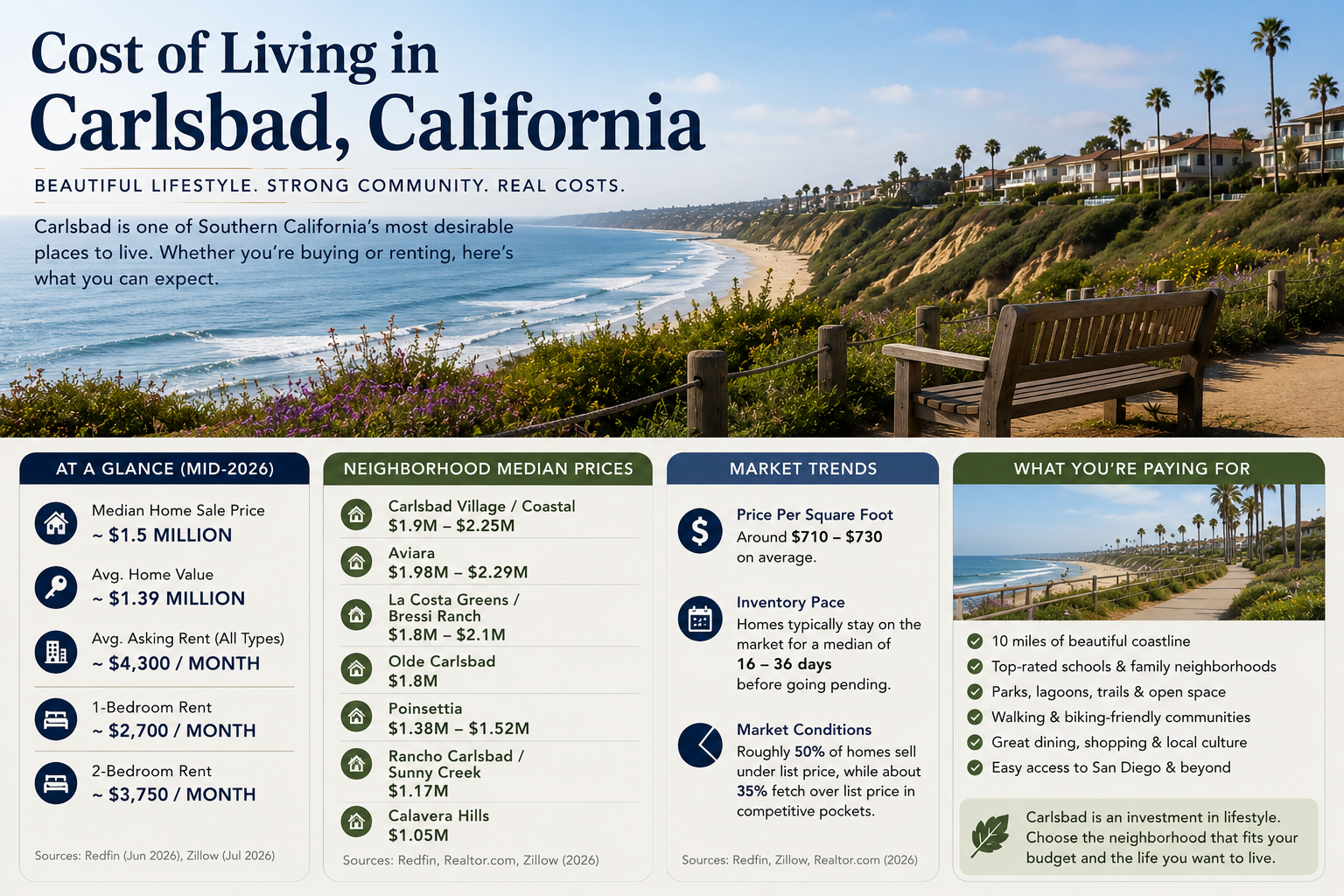
As of mid-2026, Carlsbad’s median home sale price was roughly $1.5 million, although prices vary dramatically by neighborhood, property type, size, condition, and proximity to the coast.
Current Carlsbad housing market on Redfin
You can find condos and smaller properties for considerably less, while ocean-view homes and properties in some of Carlsbad’s most desirable neighborhoods can easily cost several million dollars.
That means two people can both say, “I live in Carlsbad,” while having very different housing costs.
Neighborhood Makes a Big Difference
Carlsbad isn’t one uniform housing market.
There are four ZIP codes—92008, 92009, 92010 and 92011—and many distinctive neighborhoods.
Carlsbad Village and Olde Carlsbad appeal to people who want character, walkability, restaurants, shops and proximity to the beach.
La Costa offers established neighborhoods, hillsides and easy access to Encinitas and surrounding communities.
Aviara is known for beautiful planned neighborhoods, golf, resorts, trails and proximity to Batiquitos Lagoon.
Bressi Ranch offers a newer, community-oriented environment with shops and restaurants nearby.
Calavera Hills, Robertson Ranch, Poinsettia and South Carlsbad each provide different combinations of schools, housing, outdoor recreation and access to the coast.
Current Zillow estimates illustrate just how much values can vary: its June 2026 figures put typical values around $1.19 million in the City Center, while Aviara was near $2-2.5 million and La Costa Greens exceeded $2.1 million. These are broad market estimates rather than prices for any particular home.
What About Renting?
Renting isn’t inexpensive either.
Rental figures can vary significantly depending on how a source calculates its average. For example, Zillow’s Rental Manager reported an average asking rent of about $4,300 across all property types and bedroom counts in late July 2026. Its breakdown showed roughly $2,700 for a one-bedroom and $3,750 for a two-bedroom.
That doesn’t mean every apartment costs $4,300.
Studios, apartments, condos, townhomes, houses and luxury coastal properties all contribute to the market, so someone considering a move should look at the actual inventory matching their needs rather than relying on a citywide average.
Current Carlsbad rental market on Zillow
The “Beach Premium”
One of the easiest ways to understand Carlsbad housing is this:
The closer you get to certain highly desirable locations, the more you’re likely to pay.
Ocean views command a premium.
Walkability to the beach can command a premium.
Larger lots can command a premium.
Certain school areas and neighborhoods command premiums.
But living a few miles inland doesn’t mean giving up the Carlsbad lifestyle.
That’s one of the advantages of the city.
Even from eastern Carlsbad, you can still be relatively close to beaches, lagoons, restaurants, parks, shopping and trails.
Groceries & Everyday Expenses
Housing gets most of the attention, but everyday expenses add up too.
Groceries, dining, household services and other costs reflect the reality of living in coastal San Diego County.
Fortunately, Carlsbad residents have plenty of choices.
We have traditional supermarkets, specialty markets, farmers markets, warehouse shopping nearby, and stores such as Trader Joe’s.
And one of my favorite ways to shop is to mix things up—regular grocery shopping for basics and local businesses or farmers markets when I want something special.
Dining Out
Carlsbad has become an excellent dining destination, which can be both wonderful and dangerous for the monthly budget!
You can spend quite a bit on a special dinner at one of our fine-dining restaurants.
But you don’t have to.
Carlsbad also has:
Tacos.
Pizza.
Sandwiches.
Breakfast cafés.
Breweries.
Happy hours.
Casual neighborhood restaurants.
Farmers market foods.
And plenty of places where locals can eat without turning every meal into a special occasion.
The diversity of Carlsbad’s food scene means you can make dining as casual—or luxurious—as you’d like.
Transportation
Carlsbad is spread across approximately 39 square miles, so your transportation expenses depend heavily on where you live and work.
For many residents, a car remains the most practical way to get around.
That means budgeting for:
- Car payments
- Insurance
- Gas
- Maintenance
- Registration
- Parking when applicable
But Carlsbad does have alternatives.
The COASTER provides rail service connecting North County with San Diego, and the Carlsbad Village and Poinsettia stations can be especially valuable for commuters.
E-bikes have also changed how many locals think about shorter trips.
For people living near the Village or coast, biking can replace at least some car trips.
And that’s not just about saving money.
Riding along the coast is a pretty great commute.
Utilities
Utility costs depend heavily on the size of your home and how you use it.
Electricity, natural gas, water, trash, internet and other household services all need to be included when calculating the true cost of living.
Carlsbad’s mild coastal climate can offer one advantage.
We don’t experience the long freezing winters of colder climates, and coastal neighborhoods often benefit from ocean breezes.
Still, larger homes, air conditioning, landscaping and irrigation can significantly increase monthly expenses.
Water Matters in Southern California
Water deserves special attention.
Carlsbad’s climate is beautiful, but Southern California is naturally dry.
Homes with large lawns, gardens, pools or extensive landscaping can have considerably different water expenses from condos or homes with drought-tolerant landscaping.
It’s also another reason you’ll see so many succulents, native plants and water-conscious landscapes around the city.
Our climate shapes not only how Carlsbad looks but also what it costs to maintain a home here.
The Cost of Having Children
For families, housing is only part of the equation.
Childcare can be a major expense, along with:
Preschool.
After-school programs.
Sports.
Summer camps.
Activities.
Tutoring.
Entertainment.
And eventually, the seemingly endless amount of food teenagers can consume.
Families moving to Carlsbad often consider school location when choosing a neighborhood, so housing and education decisions can become closely connected.
Recreation: Here’s Where Carlsbad Gives Something Back
One of the best things about living in Carlsbad is that some of our greatest experiences cost little or nothing.
The beach is free.
Walking Batiquitos Lagoon is free.
Watching sunset is free.
Exploring the Village is free.
Hiking local trails is free.
A picnic at the park can be inexpensive.
Walking Terramar doesn’t require a membership.
Watching migrating birds or looking for wildflowers costs nothing.
That’s an important part of the cost-of-living equation that numbers don’t always capture.
You may spend more to live here.
But you don’t necessarily need to spend a fortune to enjoy living here.
The Outdoor Lifestyle Can Be Surprisingly Affordable
Some of my favorite Carlsbad days aren’t expensive days.
Walk the dog at Batiquitos Lagoon.
Ride an e-bike toward the coast.
Pack lunch.
Spend the afternoon at the beach.
Watch sunset.
That’s a pretty wonderful day.
And after you’ve made the initial investment in things such as a bike, paddleboard, surfboard or beach gear, outdoor recreation can become an inexpensive part of everyday life.
That’s one reason the Carlsbad lifestyle can feel different from the raw cost-of-living numbers.
You Don’t Need to Live at the Beach to Enjoy the Beach
This is something I’d especially tell someone considering moving here.
You don’t have to buy an oceanfront home to have an oceanfront lifestyle.
Live farther inland and you can still drive or bike to the beach.
You can walk the lagoons.
Have dinner in the Village.
Watch sunset at Terramar.
Spend Saturday morning on the coast.
Choosing the right neighborhood can therefore be about finding the balance between housing budget and lifestyle priorities.
Carlsbad vs. Nearby Communities
People considering Carlsbad often compare it with:
Oceanside — immediately north, with its own growing dining scene, harbor, beaches and diverse housing options.
Vista — inland, often worth considering for buyers who want to remain in North County while exploring different housing prices.
San Marcos — another inland alternative with newer development, shopping and easy access to North County.
Encinitas — south of Carlsbad and another highly desirable coastal community where housing can also be very expensive.
There isn’t one “best” choice.
It comes down to what matters most:
Beach access?
Walkability?
Lot size?
Schools?
Commute?
Restaurants?
Nightlife?
Newer construction?
Or simply getting as much home as possible for your budget?
Is Carlsbad Worth the Cost?
That’s the question only the individual or family can answer.
Carlsbad’s housing costs are undeniably high.
But people aren’t simply paying for a house.
Part of what attracts residents is access to an entire lifestyle:
Beaches + weather + schools + restaurants + parks + lagoons + trails + community + outdoor recreation + proximity to San Diego.
Whether that combination justifies the price is a personal financial decision.
For many residents, it does.
For others, living in a nearby community and visiting Carlsbad may make more financial sense.
Both can be good choices.
Cherimarie’s Local Perspective
For me, the real value of living in Carlsbad shows up in ordinary moments.
It’s being able to walk at Batiquitos Lagoon.
Ride an e-bike toward South Carlsbad State Beach.
Meet friends in the Village.
Eat at a favorite local restaurant.
Spend an afternoon by the ocean.
Or decide at the last minute to go watch sunset.
Those aren’t vacation activities.
They’re everyday life here.
Yes, Carlsbad is expensive—and I think any guide about moving here should be upfront about that.
But when people ask why residents love it so much, I think the answer is that we actually use the place where we live.
The beach isn’t something we save for vacation.
The lagoon isn’t a tourist attraction.
The Village isn’t somewhere we visit once.
They’re part of our routines.
And that’s difficult to put into a cost-of-living calculator.
Seat at the Table
Every place has a price.
In Carlsbad, that price is higher than in many communities.
The important question isn’t simply:
“How much does Carlsbad cost?”
It’s:
“What kind of life do I want that cost to provide?”
If your ideal day includes walking by the ocean, exploring a lagoon, eating at a neighborhood restaurant, riding a bike along the coast and watching the sun disappear into the Pacific, then Carlsbad offers something pretty special.
Just come into the decision with your eyes open, your budget realistic—and maybe a little extra room in it for tacos.
2026 Quick Snapshot
| Expense | Current indication |
|---|---|
| Median home sale price | About $1.5 million |
| Typical home value | About $1.39 million |
| Average asking rent, all property types | About $4,300/month |
| Average 1-bedroom asking rent | About $2,700/month |
| Average 2-bedroom asking rent | About $3,750/month |
Housing and rental markets change quickly, so these figures should be treated as a mid-2026 snapshot rather than a permanent cost guide.