
Bird Migration in Carlsbad: A Coastal Rest Stop Along the Pacific Flyway
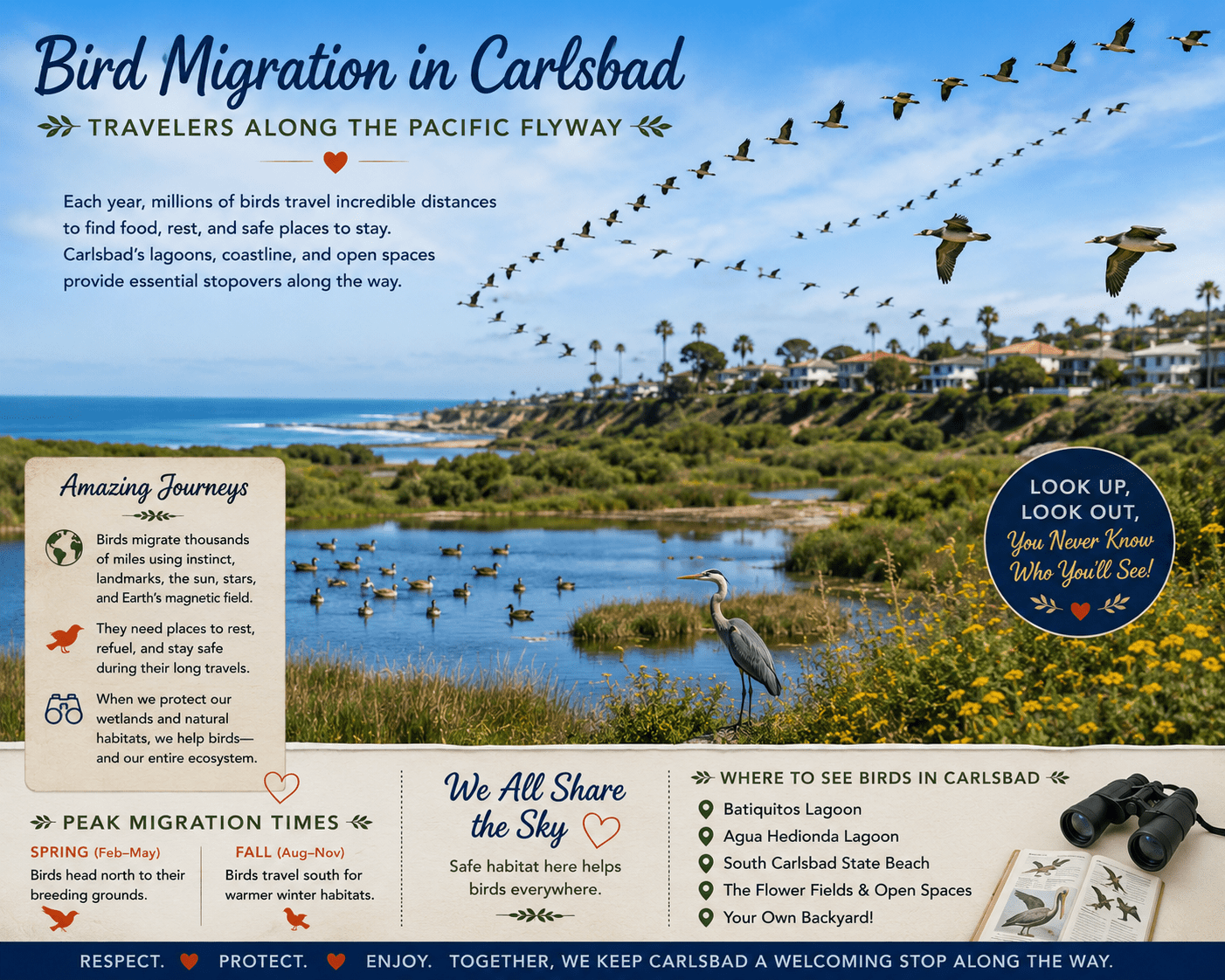
When the Travelers Have Wings
Some of Carlsbad’s most fascinating visitors never make a hotel reservation, eat at a restaurant, or spend a day at the beach.
They arrive on wings.
Throughout the year—and especially during the great spring and fall migrations—birds travel through Southern California on journeys that can cover hundreds or even thousands of miles.
Carlsbad’s lagoons, wetlands, coastline, beaches, and open spaces provide important places where birds can rest, feed, and find shelter along the way.
You may see them while walking at Batiquitos Lagoon, looking across Agua Hedionda Lagoon, strolling the beach, or simply watching the sky.
Once you begin noticing migrating birds, you’ll realize something wonderful:
Carlsbad isn’t just our home. It’s part of a much larger highway in the sky.
Carlsbad & the Pacific Flyway
Carlsbad lies along the Pacific Flyway, one of the major migratory routes used by birds traveling through western North America.
Think of the Pacific Flyway as an enormous aerial highway stretching from northern breeding grounds in Alaska and Canada through the western United States and into Mexico, Central America, and beyond.
But unlike our freeways, there aren’t clearly marked lanes.
Birds navigate using remarkable combinations of instinct, landscape features, the sun, stars, Earth’s magnetic field, and learned routes.
Along their journeys, they need safe places to stop.
That’s where coastal habitats like Carlsbad’s lagoons become especially valuable.
Why Carlsbad’s Lagoons Matter
Carlsbad has several coastal lagoons, and they are among the city’s greatest natural treasures.
For migrating birds, wetlands can function almost like roadside rest stops.
After flying long distances, birds need places where they can find:
Food. Water. Shelter. Rest.
Mudflats may contain tiny organisms for shorebirds to eat. Shallow water provides feeding areas for wading birds. Vegetation offers protection. Open water attracts ducks and other waterbirds.
Different birds need different habitats, which is why preserving a variety of wetland environments is so important.
Batiquitos Lagoon: One of My Favorite Places to Watch Birds
Batiquitos Lagoon Foundation is one of the best places in Carlsbad to slow down and start noticing birds.
The lagoon and surrounding habitat support an impressive variety of resident and migratory species.
Walking the trail gives you opportunities to see birds on the water, along the shoreline, perched in vegetation, and flying overhead.
You don’t need to be an experienced birder.
Bring binoculars if you have them, but even without them, simply stop occasionally and listen.
You’ll often hear the birds before you see them.
Batiquitos is already one of my favorite morning walks, and bird migration adds another dimension to the experience. A trail you’ve walked many times can suddenly feel completely different when seasonal visitors arrive.
Agua Hedionda Lagoon
Agua Hedionda Lagoon Foundation offers another opportunity to experience Carlsbad’s birdlife.
The lagoon’s open water, shoreline, wetland habitat, and surrounding vegetation attract many kinds of birds.
A good place to begin is the Agua Hedionda Lagoon Discovery Center, especially if you’re exploring with children.
Learning a few bird names before heading outside can transform the experience.
Instead of seeing “a bunch of birds,” children start asking:
Was that an egret?
Is that a pelican?
Why does that bird have such long legs?
And suddenly they’re observing rather than simply walking.
The Beach Is Part of the Migration Story Too
Don’t limit your birdwatching to the lagoons.
Carlsbad’s coastline is another wonderful place to observe birds.
Walk along the beach and you may encounter shorebirds running along the water’s edge, gulls resting on the sand, pelicans flying in formation above the waves, and seabirds farther offshore.
Some birds are year-round residents.
Others are seasonal visitors.
And still others may simply be passing through.
That means the birds you see during a January beach walk can be very different from those you encounter in July.
Birds You May See Around Carlsbad
The exact species vary according to habitat and season, but keep an eye out for some of these familiar coastal visitors and residents.
Brown Pelicans
Few birds say “California coast” quite like the Brown Pelican.
Watch for groups flying remarkably close to the ocean surface or gliding in formation along the coastline.
Their prehistoric-looking silhouettes make them easy to recognize.
Great Blue Herons
Tall and elegant, Great Blue Herons can often be seen standing almost motionless near water.
Their patience is extraordinary.
They may wait quietly before suddenly striking to capture a fish or other prey.
Great & Snowy Egrets
Bright white egrets are especially beautiful against the blue water of Carlsbad’s lagoons.
Great Egrets are larger, while Snowy Egrets are smaller and known for their distinctive yellow feet.
Ducks
During migration and winter, wetlands can attract a variety of ducks.
Instead of assuming every duck is the same, look carefully at differences in size, coloring, bill shape, and behavior.
Learning to distinguish them can quickly become addictive.
Shorebirds
Sandpipers and other shorebirds often feed along mudflats, beaches, and shallow water.
Some have extraordinarily long migration routes.
That tiny bird running along the shoreline may have traveled farther than many of us do on vacation.
Ospreys
Look overhead near the lagoons and you may spot an Osprey.
These impressive raptors specialize in catching fish and can sometimes be seen hovering or diving toward the water.
Terns
Graceful terns can often be seen flying over coastal waters while searching for fish.
Their quick dives make them especially fun to watch.
Spring Migration: Heading North
Spring migration generally brings birds north toward their breeding grounds.
For some species, Southern California is their destination.
For others, we’re simply one stop along a much longer journey.
This is also a beautiful season for birdwatching because Carlsbad’s landscape begins changing.
Wildflowers bloom.
Insects become more active.
Plants produce new growth.
And additional food becomes available.
Our Wildflower Guide, Monarch Butterfly story, and Bird Migration Guide all connect here because they’re really telling different parts of the same seasonal story.
Spring brings Carlsbad’s ecosystems to life.
Fall Migration: Heading South
During fall, the movement reverses.
Birds begin traveling toward wintering grounds farther south.
Migration isn’t one single event where every species leaves on the same day. Different birds move at different times, sometimes over weeks or months.
That makes fall an especially interesting season for repeated visits to the lagoons.
Visit one week.
Return a few weeks later.
You may notice completely different birds.
Winter Visitors
Winter can also be a rewarding time for birdwatching in coastal Southern California.
While much of the country is dealing with snow and freezing temperatures, Carlsbad’s relatively mild climate and coastal wetlands provide habitat for birds spending the colder months here.
In other words, we’re not the only ones who think winter in Carlsbad sounds pretty good.
How Do Birds Know Where to Go?
This is one of the most amazing parts of migration.
Birds can use several navigational tools.
Some follow coastlines, rivers, mountain ranges, or other geographic landmarks.
Others use the position of the sun and stars.
Research has also shown that many birds can sense Earth’s magnetic field.
And some migration behaviors are inherited.
Imagine a young bird taking its first major journey without a map, GPS, or road signs—and still knowing which direction to travel.
It’s one of nature’s great mysteries and wonders.
Why Birds Migrate
Migration is largely about survival.
Birds move to find favorable conditions for:
- Food
- Breeding
- Nesting
- Raising young
- Avoiding harsh seasonal weather
But migration is demanding.
Birds need tremendous amounts of energy to travel long distances.
That’s why stopping places matter.
A healthy wetland isn’t simply a pretty landscape.
For a migrating bird, it can be the difference between successfully completing a journey and not having enough energy to continue.
A Family Birdwatching Adventure
Birdwatching is one of the easiest nature activities to enjoy with children.
You don’t need expensive equipment or expert knowledge.
Start with a simple scavenger hunt.
Can you find:
- A bird with long legs?
- A bird swimming?
- A bird diving for fish?
- A bird with a long bill?
- A white bird?
- A bird flying in formation?
- A bird standing perfectly still?
- Three different kinds of ducks?
- A bird making an unusual sound?
- A bird you’ve never seen before?
Let children make their own observations before worrying about identifying every species.
Curiosity comes first.
Try a Sit Spot
Here’s one of my favorite ways to experience a lagoon.
Instead of walking the entire trail, choose one place with a good view and sit quietly for ten minutes.
At first, you may think nothing is happening.
Then you’ll begin noticing things.
A bird calls from the bushes.
Something lands on the water.
A heron moves along the shoreline.
Pelicans pass overhead.
A tiny bird hops between branches.
Nature often reveals itself when we stop moving.
Bird Photography Tips
You don’t need a giant camera lens to enjoy photographing birds.
Instead of trying only for close-ups, include the surrounding landscape.
A pelican flying above the Pacific.
An egret standing beside the lagoon.
A flock silhouetted against a Carlsbad sunset.
Those photographs tell the story of birds in Carlsbad, rather than simply showing a bird.
And always give wildlife plenty of space.
If a bird repeatedly moves away from you, that’s a good indication you’re too close.
Protecting the Places Birds Need
Migratory birds face many challenges.
Habitat loss, changing environmental conditions, pollution, invasive species, human disturbance, and other pressures can make already difficult journeys even harder.
Protecting coastal wetlands and natural areas therefore has significance far beyond Carlsbad.
A bird resting at Batiquitos Lagoon today may later continue hundreds or thousands of miles away.
When we protect habitat here, we’re participating in a conservation network that stretches across continents.
Cherimarie’s Local Perspective
One of the things I love most about walking at Batiquitos Lagoon is that I never know exactly what I’ll see.
Some mornings it’s incredibly peaceful.
Other days the lagoon seems filled with activity.
Pelicans fly overhead. Egrets search the shallows. Ducks gather on the water. A heron stands so still that you almost miss it.
And once you understand migration, you begin wondering about the birds you see.
Where did that bird come from?
How long has it been traveling?
Where is it going next?
Suddenly a simple morning walk becomes connected to something happening across the entire continent.
That’s pretty extraordinary.
Create a Carlsbad Nature Day
Bird migration fits beautifully into a Carlsbad nature itinerary.
Begin early at Batiquitos Lagoon, when birds and other wildlife are active and the trail is quiet.
Spend some time simply watching.
Later, explore Agua Hedionda Lagoon and visit the Discovery Center.
During spring, combine the day with wildflower and butterfly watching.
Then finish with a walk along the coast around sunset, watching for pelicans and other seabirds overhead.
You may begin the day thinking you’re going for a walk.
You’ll finish realizing you’ve been exploring an ecosystem.
Seat at the Table
Migration reminds us that nature doesn’t recognize city boundaries.
A bird doesn’t know when it has entered Carlsbad.
It knows only that it has found water.
Food.
Shelter.
A place to rest.
Then, when the time is right, it continues its journey.
That’s what makes our lagoons and natural spaces so important.
They’re part of something much larger than ourselves.
The next time you’re walking beside a Carlsbad lagoon and see a flock settling onto the water, stop for a moment.
They may have traveled hundreds of miles to get here.
And tomorrow, they may be gone.
For one small part of an extraordinary journey, Carlsbad was their home.
Explore More of Carlsbad’s Natural Side
This story belongs with the Batiquitos Lagoon, Agua Hedionda Lagoon, Wildlife Guide, Wildflower Guide, Monarch Butterflies, Photography Guide, Favorite Morning Walks, Hiking, and Seasonal Carlsbad stories in the Discover Carlsbad Library.
Together, these stories can form a dedicated Nature & Wildlife Collection within the Carlsbad Food Tours Storytelling Playbook—showing visitors that discovering Carlsbad means looking beyond restaurants, beaches, and attractions to the remarkable natural world surrounding them.