
Monarch Butterflies in Carlsbad: Following One of Nature’s Most Remarkable Journeys
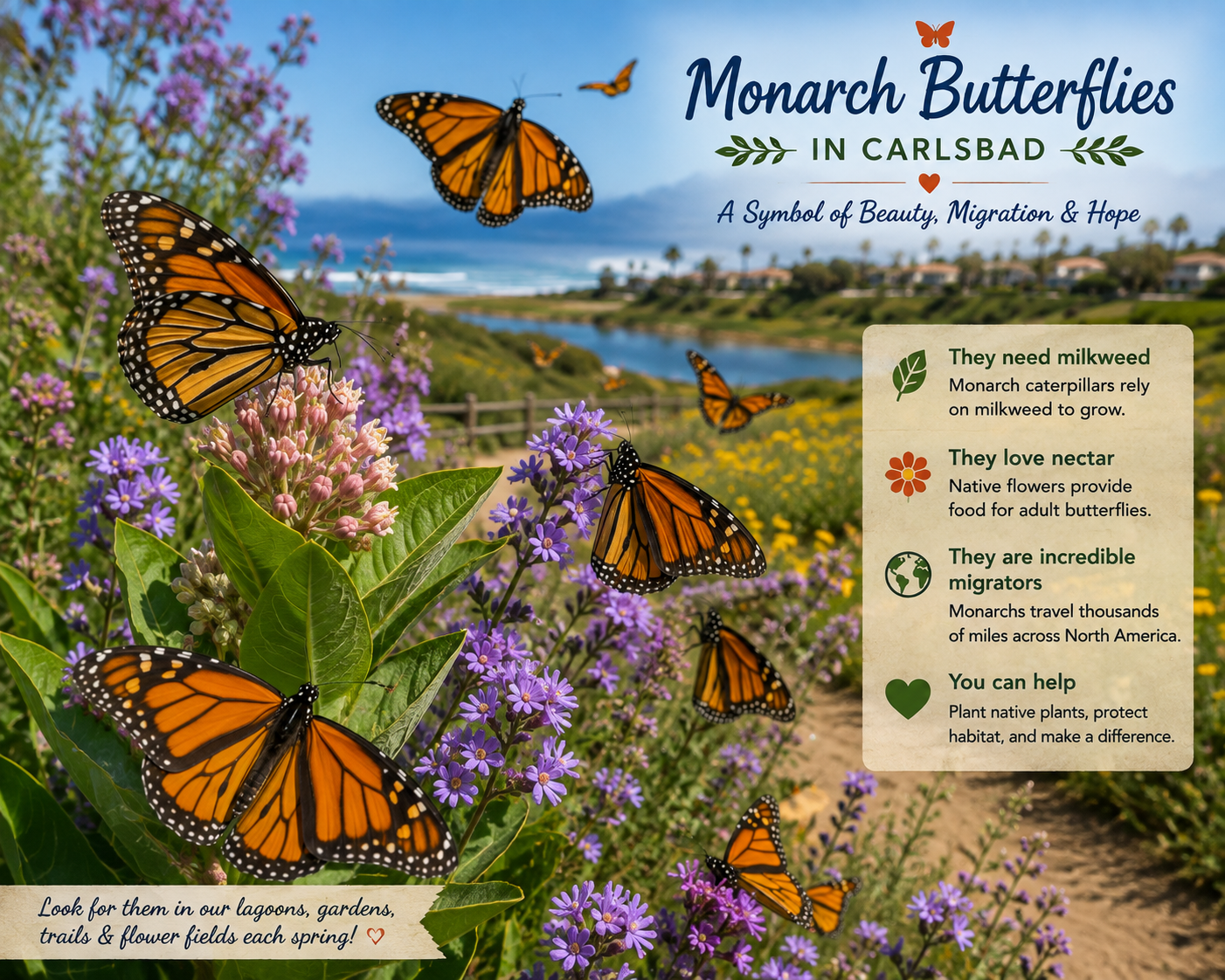
A Flash of Orange in the Carlsbad Sky
There is something magical about spotting a Monarch butterfly in Carlsbad.
Its brilliant orange-and-black wings are unmistakable as it floats between flowers, pauses to feed on nectar, or disappears into the coastal landscape.
But the Monarch is much more than a beautiful butterfly.
It is part of one of nature’s most extraordinary migration stories—and here along the Southern California coast, we have an opportunity to appreciate these remarkable insects while also learning why the plants and habitats around us matter so much.
For families, photographers, gardeners, and nature lovers, searching for Monarchs adds another wonderful dimension to exploring Carlsbad.
Meet the Western Monarch
The Monarch butterfly (Danaus plexippus) is famous for its long-distance migrations.
In western North America, Monarchs generally live west of the Rocky Mountains and historically migrated to overwintering sites along the California coast, where relatively mild temperatures provide protection during the colder months.
Some Monarchs also move between western states and Mexico, making their migration patterns more complicated than we once understood.
What makes the journey particularly remarkable is that it occurs across multiple generations.
The butterfly you see in Carlsbad may be participating in a journey that began generations before it was born.
Why Coastal California Matters
Southern California’s climate makes the region important for Monarchs.
Coastal areas can provide relatively mild winter conditions along with flowering plants that offer nectar.
Historically, groves of trees along the California coast have also provided protected places where Monarchs could gather during winter.
Carlsbad’s lagoons, gardens, open spaces, coastal vegetation, and flowering landscapes all help create the kind of interconnected environment that butterflies and other pollinators use.
That’s one reason preserving natural habitat matters even in a developed coastal city.
Where to Look for Monarchs in Carlsbad
There isn’t one guaranteed “Monarch spot.” Butterflies move according to weather, season, flowering plants, and available habitat.
Instead, think about places where you are likely to find flowers and native vegetation.
Batiquitos Lagoon
Batiquitos Lagoon Foundation is a wonderful place for a nature walk.
The lagoon’s coastal habitat supports a wide variety of plants and wildlife. When flowers are blooming, watch for butterflies visiting nectar sources along the trail.
I already love Batiquitos for morning walks, so spotting a Monarch there feels like an extra little gift from nature.
Agua Hedionda Lagoon
The area surrounding Agua Hedionda Lagoon Foundation is another good place to learn about Carlsbad’s natural environment.
Visit the Discovery Center and then explore the surrounding landscape. Even when Monarchs aren’t present, you’ll begin noticing the plants, insects, birds, and other wildlife that together create a functioning ecosystem.
The Flower Fields
The Flower Fields at Carlsbad Ranch celebrates another side of Carlsbad’s relationship with flowers and pollinators.
Families can explore beautiful spring blooms while also learning to look more closely at the bees, butterflies, and other creatures visiting flowers.
The combination makes this a natural companion to our Carlsbad Wildflower Guide.
Milkweed: The Plant Monarchs Can’t Live Without
If there is one plant to know when learning about Monarchs, it is milkweed.
Adult Monarchs visit many kinds of flowers for nectar.
But Monarch caterpillars are different.
Milkweed is their essential host plant.
Female Monarchs lay their eggs on milkweed. When the tiny caterpillars hatch, they begin feeding on the plant.
This relationship means that protecting appropriate milkweed habitat is an important part of Monarch conservation.
It also gives children a wonderful way to understand that butterflies don’t simply need flowers.
They need an entire habitat that supports every stage of their life cycle.
From Egg to Butterfly
The Monarch life cycle is fascinating to watch.
It begins when a female lays a tiny egg on milkweed.
The egg hatches into a caterpillar, also called a larva.
The caterpillar spends its time eating and growing, eventually developing the familiar yellow, black, and white stripes associated with Monarch caterpillars.
Next comes one of nature’s most remarkable transformations.
The caterpillar forms a beautiful green chrysalis decorated with tiny golden markings.
Inside, an extraordinary transformation takes place.
Eventually, an adult Monarch emerges.
After its wings expand and dry, it flies away—and the cycle begins again.
Create a Monarch-Friendly Garden
You don’t have to visit a preserve to help butterflies.
Our own gardens can become small pieces of habitat.
Native flowering plants can provide nectar not only for Monarchs but also for other butterflies, bees, hummingbirds, and pollinating insects.
For coastal Southern California, it’s important to choose plants appropriate for the local environment rather than simply buying any plant labeled “butterfly friendly.”
The Xerces Society for Invertebrate Conservation provides science-based guidance about Monarch conservation, milkweed, and pollinator habitat.
Even a relatively small garden can contribute flowers and shelter within a larger network of habitat.
Monarchs Need More Than Milkweed
Milkweed receives a lot of attention, but adult Monarchs also need nectar plants.
A butterfly traveling long distances needs energy.
Flowering native plants act almost like little refueling stations along the journey.
That’s why biodiversity matters.
A landscape filled with different native plants that bloom at different times can provide food for butterflies and other pollinators across a much longer season.
A Fun Monarch Hunt for Kids
A butterfly walk is one of the easiest ways to introduce children to nature.
Instead of asking them simply to “look for butterflies,” turn the walk into a nature hunt.
See if they can find:
- An orange butterfly
- A Monarch caterpillar
- Milkweed
- A butterfly drinking nectar
- A bee visiting the same flower
- Three different flower colors
- A butterfly resting with its wings closed
- A butterfly basking with its wings open
- A chrysalis
- Another type of butterfly
The important rule is simple:
Look, photograph, and enjoy—but don’t disturb.
Monarch or Look-Alike?
Not every orange butterfly you see in Carlsbad is a Monarch.
Several butterflies can appear similar when they’re flying quickly past you.
A Monarch typically has large orange wings divided by bold black veins and surrounded by a black border containing small white spots.
Instead of chasing one for a closer look, wait.
Butterflies often settle onto flowers to feed, giving you a much better opportunity to observe and photograph them.
Photographing Monarchs
Butterfly photography rewards patience.
Find a patch of flowers and stay still.
Instead of following a butterfly from flower to flower, let it come to you.
Morning can be especially enjoyable because butterflies may be less active while temperatures are cooler.
Use a zoom if you have one, and avoid getting so close that the butterfly repeatedly flies away.
Sometimes the most beautiful photograph isn’t a close-up.
A Monarch feeding among California wildflowers with a lagoon or blue Carlsbad sky behind it tells a much richer story about where the butterfly lives.
Why Monarch Conservation Matters
The western Monarch population has experienced dramatic declines over the past several decades. Numbers can fluctuate substantially from year to year, but the long-term decline has made protection of habitat, nectar plants, overwintering areas, and appropriate milkweed increasingly important.
Monarchs also serve as powerful ambassadors for a much bigger conservation story.
When we create healthy habitat for Monarchs, we’re often helping many other creatures at the same time:
Bees.
Other butterflies.
Birds.
Native insects.
And the plants that depend upon pollinators.
Saving one butterfly can teach us how interconnected an ecosystem really is.
Cherimarie’s Local Perspective
One of the things I love about living in Carlsbad is how easily nature becomes part of an ordinary day.
You can be walking along Batiquitos Lagoon, enjoying the view and thinking about something completely unrelated—and suddenly an orange butterfly floats across the trail.
For a moment, you stop.
That’s what I love about Monarchs.
They’re small, but they make you pay attention.
And once you learn about the incredible journey behind those orange wings, seeing one feels even more special.
It reminds me that Carlsbad isn’t only about the beautiful places we can see.
It’s also about protecting the living things that depend upon those places.
Pair a Monarch Walk With Carlsbad’s Wildflowers
Spring is a wonderful time to combine butterfly watching with our Carlsbad Wildflower Guide.
Start with a morning walk at Batiquitos Lagoon or another natural area.
Look for wildflowers and watch to see which insects are visiting them.
Then explore one of Carlsbad’s gardens or spring attractions.
Instead of simply asking, What flowers are blooming?, ask another question:
Who’s visiting them?
Suddenly the flowers become part of a much larger story.
Seat at the Table
The Monarch butterfly weighs almost nothing.
Yet generation after generation, these fragile-looking creatures undertake journeys spanning enormous distances.
They depend upon milkweed.
They depend upon flowers.
They depend upon habitat.
And ultimately, they depend upon communities willing to leave room for nature.
The next time a Monarch passes you on a Carlsbad trail, stop for a moment and watch.
That little flash of orange isn’t simply another butterfly.
It’s a traveler—and for a few moments, Carlsbad is part of its journey