
Historic Churches of Carlsbad: Faith, Architecture & Community Through the Years
More Than Places of Worship
Some of Carlsbad’s most meaningful historic places aren’t grand hotels or commercial buildings. They’re the churches where generations of residents gathered for worship, weddings, baptisms, funerals, celebrations, and community events.
Exploring Carlsbad’s historic churches offers another way to understand how the city grew. These buildings tell stories of faith, architecture, immigration, family, and the people who created a sense of community long before Carlsbad became the coastal destination we know today.
St. Michael’s by-the-Sea Episcopal Church
One of the most recognizable historic churches in Carlsbad Village is St. Michael’s by-the-Sea Episcopal Church.
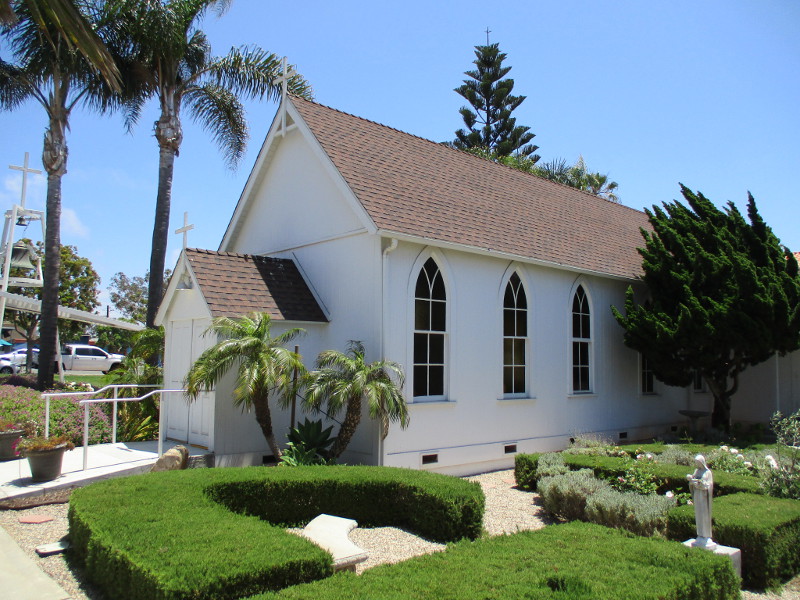
The congregation dates to 1894, making it an important part of Carlsbad’s early community history. Its historic chapel, with its simple white exterior, steeply pitched roof, and Gothic-style pointed windows, feels almost like a small country church preserved in the middle of today’s busy Village.
Walk around the grounds and you’ll immediately notice the contrast between this peaceful historic property and the modern city surrounding it.
St. Michael’s is particularly interesting because it reminds us just how small early Carlsbad once was. Churches weren’t simply places people visited on Sunday. They were gathering places where relationships were formed, families celebrated important milestones, and neighbors supported one another.
St. Patrick Catholic Church
St. Patrick Catholic Church has also played an important role in Carlsbad’s community life.
Its story is closely connected to Carlsbad’s growth and to generations of local Catholic families. As the community expanded, so did the parish, eventually becoming one of the city’s established faith communities.
The history of Catholic life in Carlsbad also connects naturally with the story of the Barrio, where Mexican and Mexican-American families helped shape the agricultural, cultural, and community life of the city.
Those connections between faith, family, work, and neighborhood are an important part of understanding Carlsbad’s history.
Carlsbad Community Church
Carlsbad Community Church is another longstanding part of the city’s religious and community landscape.
Like many early community churches, its significance extends beyond Sunday services. Churches historically provided places for meetings, children’s activities, celebrations, charitable efforts, and social gatherings.
As Carlsbad grew from a small agricultural and railroad community into an incorporated city and eventually a major coastal destination, congregations such as these grew alongside it.
The Architecture Tells a Story Too
Historic churches are especially interesting stops on an architecture walk because their designs often reflect the period in which they were built.
Look for details such as:
- Steeply pitched roofs
- Pointed Gothic-style windows
- Traditional wooden construction
- Stained glass
- Bells and bell towers
- Simple early California craftsmanship
- Crosses and religious symbols
- Gardens and gathering spaces
The historic chapel at St. Michael’s is a particularly good example of how a relatively modest building can have enormous visual and historical significance.
It doesn’t need to be massive or elaborate.
Its beauty comes partly from its simplicity.
Churches as Community Gathering Places
To really appreciate these buildings, it’s helpful to imagine Carlsbad before freeways, subdivisions, resorts, and shopping centers.
Early residents didn’t have endless choices for entertainment and social activities.
Churches were among the places where people came together.
A Sunday service might also mean seeing neighbors, exchanging news, introducing a new baby, celebrating a marriage, organizing assistance for a family, or planning a community event.
In that sense, churches helped build more than congregations.
They helped build community.
Faith & Carlsbad’s Agricultural Families
The history of Carlsbad’s churches also overlaps with another major part of our story—agriculture.
For generations, families worked in Carlsbad’s flower fields, strawberry fields, avocado groves, bean fields, and other agricultural operations.
Many of these families established deep roots in the community, and churches became important places for worship, celebrations, family traditions, and support.
When we tell Carlsbad’s agricultural history, it’s important to remember that these weren’t simply stories about crops.
They were stories about people.
Their homes, schools, churches, businesses, and neighborhoods together created the community Carlsbad eventually became.
Add Historic Churches to Your Village Walk
Historic churches fit beautifully into a walking exploration of Carlsbad Village.
You can combine them with stops at:
Carlsbad Santa Fe Depot → Historic Village buildings → St. Michael’s by-the-Sea → Magee Park and Magee House → the former Twin Inns → the Barrio
Along the way, you’ll see how transportation, commerce, religion, agriculture, architecture, and family life all contributed to Carlsbad’s development.
Rather than viewing each landmark as an isolated attraction, you begin seeing how all the stories connect.
Cherimarie’s Local Perspective
I think historic churches sometimes get overlooked when people explore a city’s history.
We notice the grand Victorian house or the old railroad depot because they immediately look historic. But churches tell us something different.
They tell us about people’s everyday lives.
These were places where families celebrated some of their happiest moments and gathered during some of their most difficult ones. Children grew up attending services here. Couples were married here. Generations of families formed friendships and traditions within these walls.
When I look at a historic church like St. Michael’s, I don’t just see a beautiful old building.
I think about all the Carlsbad stories that have passed through its doors.
A Quiet Kind of History
One of the things I love about visiting historic churches is that they encourage you to slow down.
Walk around the grounds.
Notice the windows.
Look at the roofline.
Read the plaques.
Imagine what the surrounding neighborhood looked like when the church was young.
Then look at the modern buildings around it.
That contrast helps us appreciate just how much Carlsbad has changed—and why preserving pieces of its past matters.
Seat at the Table
Carlsbad’s history wasn’t created only by developers, farmers, business owners, or city leaders.
It was created by families.
And for many of those families, faith communities were an important part of life.
Historic churches preserve those quieter stories—the weddings, Sunday mornings, friendships, celebrations, traditions, and generations of people who gathered together.
They’re reminders that a city’s history isn’t simply measured by the buildings it constructs.
It’s measured by the communities created inside them.
Continue Your Historic Carlsbad Walk
Pair this story with the Historic Downtown Walk, Architecture Walk, Magee Park Walk, Barrio neighborhood story, and Public Art Walk in the Discover Carlsbad Library. Together, they create a wonderful collection of self-guided walks that allow visitors to experience Carlsbad beyond the beach.
And that’s also what we love sharing through Carlsbad Food Tours—not simply where to eat, but the stories of the people and places that made Carlsbad what it is today.
Taste the Food. Hear the Stories. Feel Like a Local.