
Whale Season in Carlsbad: Watching the Pacific’s Great Travelers
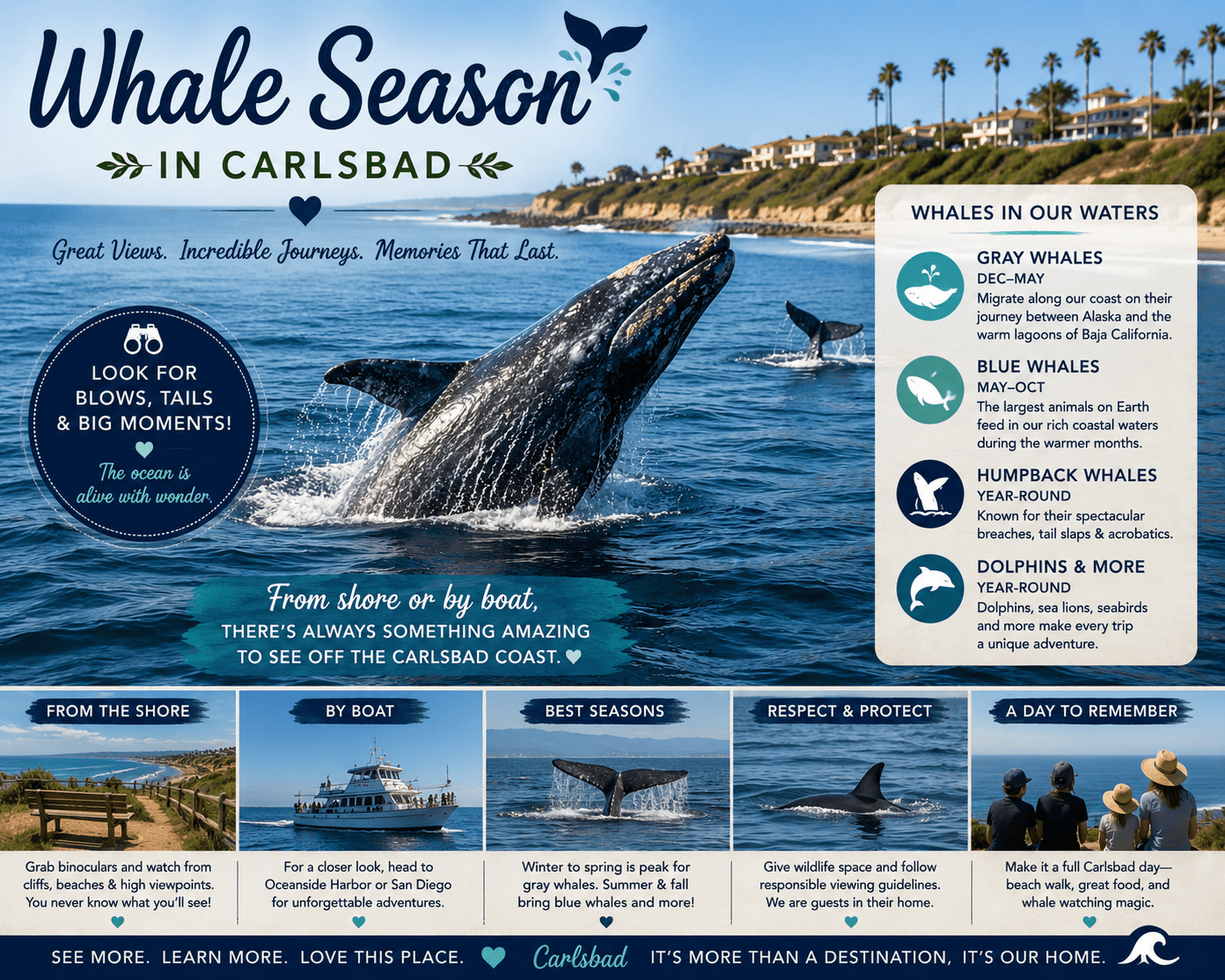
When Giants Pass Our Coast
There is something extraordinary about standing on the Carlsbad coast, looking across the Pacific, and realizing that somewhere beyond the waves a whale may be passing by.
Whales are among Carlsbad’s most impressive seasonal visitors. Like the migrating birds that stop at our lagoons and the Monarch butterflies that move through Southern California, whales remind us that our little stretch of coastline is connected to a much larger natural world.
And the wonderful thing about whale watching in Southern California is that there really isn’t just one whale season.
Different species can be seen at different times of year, making the waters off North County San Diego an exciting place to watch for marine life almost year-round.
Winter & Spring: Gray Whale Migration
The classic Southern California whale-watching season is the gray whale migration, generally associated with winter and spring.
Each year, gray whales undertake one of the great migrations of the animal kingdom, traveling between feeding areas in the Arctic and breeding and calving lagoons in Baja California, Mexico.
During their southbound migration, whales move along the California coast toward Mexico.
Later, they make the return journey north.
That means Carlsbad sits beside one of nature’s great migration corridors.
December Through February: Heading South
During winter, gray whales generally travel south toward the warm lagoons of Baja California.
This is a wonderful time to stand at a high coastal viewpoint with binoculars and scan the horizon.
Look for a whale’s blow—the misty plume created when a whale exhales at the surface.
Sometimes that’s the first clue that a whale is nearby.
Then watch carefully.
You may see the curve of its back as it surfaces again before disappearing beneath the water.
March Through May: The Journey North
Spring brings another exciting chapter.
Gray whales begin returning north toward their feeding grounds.
This period can be especially interesting because mothers may be traveling with calves.
Imagine that journey.
A young whale born in the warm waters of Mexico begins traveling thousands of miles north alongside its mother, passing the beaches and bluffs of Southern California along the way.
Suddenly, looking out from a Carlsbad beach feels very different.
That tiny splash in the distance might be part of an enormous journey.
Summer & Fall: Blue Whales
Gray whales may be the stars of winter, but summer brings the possibility of seeing something even larger.
Blue whales can occur off Southern California when feeding conditions are favorable.
The blue whale is the largest animal known to have lived on Earth.
Just think about that for a moment.
Larger than an elephant.
Larger than the biggest dinosaurs known from many fossil groups.
And one could be swimming offshore while you’re sitting on a Carlsbad beach.
Their presence varies with ocean conditions and food availability, so sightings are never guaranteed. But the possibility makes summer whale watching particularly exciting.
Humpback Whales
Humpback whales are another species that may be encountered off Southern California.
They’re famous for their acrobatic behavior.
A humpback may slap the surface with its tail or flippers, and occasionally one will launch much of its enormous body out of the water in a spectacular breach.
Seeing a whale surface is exciting.
Seeing one breach is something you remember for the rest of your life.
Fin Whales & Other Visitors
The waters off Southern California can also host fin whales, along with several other cetacean species.
Fin whales are among the largest animals on Earth and can sometimes be seen offshore throughout the year.
The diversity of marine mammals in our region is one reason Southern California is such an interesting whale-watching destination.
You never know exactly what the ocean is going to show you.
Dolphins Are Part of the Adventure
Even on a day when whales are difficult to find, the ocean may have another surprise waiting.
Dolphins.
Southern California waters are home to several dolphin species, and large groups can sometimes be encountered offshore.
Watching dolphins race through the water, leap beside a boat, or surf through waves is every bit as exciting for many visitors as seeing a whale.
They’re also a wonderful reminder that whale watching is really marine wildlife watching.
The whale may be the goal.
But the entire ocean is the experience.
Can You See Whales From Carlsbad?
Yes—sometimes.
You don’t necessarily need to board a boat to participate in whale season.
On clear days, especially during migration periods, patient observers may spot whales from elevated areas along the Carlsbad coast.
Bring binoculars and choose somewhere with a wide, unobstructed ocean view.
Then slow down.
Whale watching from land requires patience.
Don’t look for an entire whale.
Look for movement.
A blow.
A splash.
A dark shape breaking the surface.
Once you spot one, keep watching the same area.
Whales generally surface multiple times before making a deeper dive.
Where to Look From Shore
Carlsbad’s coastline offers plenty of opportunities for ocean watching.
Good possibilities include elevated coastal areas around:
Terramar
Carlsbad State Beach
South Carlsbad State Beach
Coastal bluffs and overlooks
Areas along Carlsbad Boulevard with broad ocean views
Terramar is especially appealing because the elevated coastal landscape can provide a beautiful perspective across the Pacific.
Even when you don’t see a whale, you’ve still spent time looking at one of Carlsbad’s best views.
That’s not a bad consolation prize.
For a Closer Look, Head to the Harbor
Carlsbad doesn’t have its own ocean marina, so visitors wanting a dedicated whale-watching cruise generally need to travel to a nearby harbor.
Oceanside Harbor is conveniently located just north of Carlsbad and provides access to ocean excursions.
San Diego also offers numerous whale-watching departures farther south.
Boat trips provide the opportunity to travel offshore into areas where whales, dolphins, sea lions, and seabirds may be feeding or migrating.
How to Spot a Whale
Whale watching becomes much easier when you know what you’re looking for.
Look for the Blow
A whale’s exhalation can create a visible mist above the surface.
From shore, it may look like a brief puff on the horizon.
Watch the Birds
Groups of seabirds feeding intensely in one area can sometimes indicate abundant marine life below.
Fish attract birds.
Fish may also attract dolphins and larger marine predators.
Look for Repeated Movement
If you see a dark shape once, don’t immediately move your binoculars.
Keep watching.
The whale may surface again nearby.
Scan Slowly
Instead of constantly moving your eyes across the entire horizon, divide the ocean into sections.
Watch one area carefully before moving to the next.
Whale watching rewards patience.
Why Do Whales Migrate?
Migration helps whales move between areas that serve different purposes.
For gray whales, northern waters provide rich seasonal feeding opportunities, while protected lagoons in Baja California offer important breeding and calving habitat.
Their journey connects ecosystems thousands of miles apart.
That’s what makes seeing one from Carlsbad so remarkable.
The whale isn’t visiting Carlsbad in the way we think of visiting somewhere.
We’re simply standing beside the route it has traveled for generations.
Whales & the Pacific Flyway
I love connecting this story with our Bird Migration article because the two migrations are happening almost on top of each other.
Look toward the lagoons and skies and you may see birds moving along the Pacific Flyway.
Turn toward the ocean and whales may be traveling along the coastline.
In spring, Monarch butterflies and other pollinators may also be moving through our landscape.
Carlsbad sits at an incredible intersection of migration.
Sky, land, wetlands, and ocean are all connected.
A Family Whale-Watching Challenge
Turn a trip to the coast into a nature scavenger hunt.
See who can spot:
- A whale blow
- A dolphin
- A pelican
- A sea lion
- A whale’s back
- A tail fluke
- A flock of seabirds
- A fishing boat
- A surfer
- Something unexpected
Children may spend ten minutes searching for a whale and end up noticing twenty other things happening around them.
That’s exactly the point.
Nature teaches us to pay attention.
Photographing Whales
Whales are difficult to photograph from shore, and that’s okay.
Sometimes it’s better to simply watch.
If you’re using a camera or phone, don’t spend the entire encounter staring at your screen.
Take a few photographs and then put it down.
Watch the whale.
Watch where it surfaces.
Listen to the ocean.
Some experiences don’t need a perfect photograph to become a perfect memory.
Respecting Marine Wildlife
Whales are wild animals, and responsible whale watching means giving them space.
Professional vessel operators are required to follow wildlife-viewing regulations and responsible boating practices.
If you’re boating independently, never chase, surround, feed, touch, or intentionally approach marine mammals too closely.
The goal should always be:
Observe without interfering.
The ocean is their home.
We’re the visitors.
Cherimarie’s Local Perspective
One of the things I love about living near the ocean is knowing that there’s an entire world moving past us that we rarely see.
You can walk along the beach, watch the sunset, and think the Pacific looks completely empty.
But it isn’t.
Dolphins may be traveling just offshore.
Pelicans are following the coastline.
Fish are moving beneath the surface.
And somewhere farther out, a whale may be making a journey that stretches thousands of miles.
I think that makes our coastline even more special.
The ocean isn’t simply our beautiful backdrop. It’s alive.
Create a Carlsbad Whale-Watching Day
During gray whale season, start with a morning walk along the coast.
Bring binoculars and spend some time scanning the horizon from an elevated viewpoint.
Then head into Carlsbad Village for breakfast or lunch.
If you want a closer ocean experience, continue north to Oceanside Harbor for a whale-watching excursion.
Return to Carlsbad in the afternoon and finish the day with sunset at the beach.
Even if the whales decide not to cooperate, you’ll have experienced one of the best things about Carlsbad:
A day built around the Pacific.
Seat at the Table
Whales remind us how small our little corner of the world really is.
A gray whale may begin its journey thousands of miles north of us, pass Carlsbad, continue into Mexico, and eventually make the entire trip again.
It doesn’t know where one city ends and another begins.
It follows currents, coastlines, instinct, food, and generations of ancient memory.
And for a brief moment, we get to witness that journey.
So during whale season, bring your binoculars to the beach.
Look beyond the waves.
Watch for that little puff of mist on the horizon.
And remember:
Sometimes the most extraordinary visitor to Carlsbad never comes ashore.
Explore More of Carlsbad’s Natural Side
This story fits beautifully with the Bird Migration, Monarch Butterflies, Wildlife Guide, Batiquitos Lagoon, Agua Hedionda Lagoon, Fishing, Sailing, Surfing, Photography Guide, Favorite Beach Walks, Terramar, and Seasonal Carlsbad stories in the Discover Carlsbad Library.
Together, they strengthen a wonderful Nature, Wildlife & Seasonal Experiences Collection within the Carlsbad Food Tours Storytelling Playbook.