Avocado Season in Carlsbad: A Taste of Our Hillside Farming Heritage
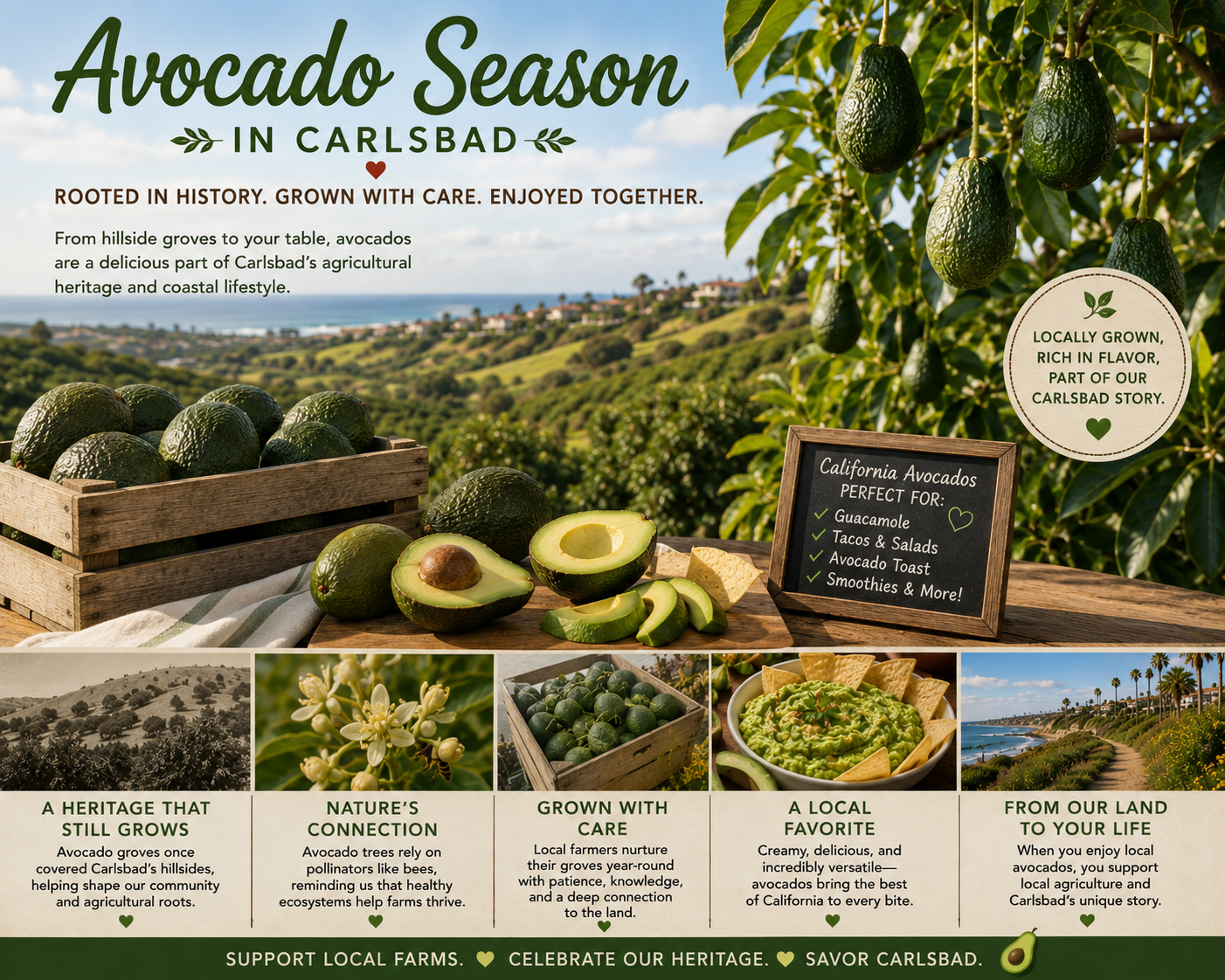
When Avocado Groves Covered the Hills
Before many of Carlsbad’s neighborhoods climbed across the hillsides, those hills looked very different.
Instead of rooftops, roads, and landscaped communities, you might have seen rows of avocado trees covering the slopes.
Avocados became an important part of the agricultural story of Carlsbad and greater North County San Diego. Our mild coastal climate offered favorable conditions for growing this uniquely Californian crop, and avocado groves became a familiar part of the landscape.
Today, many of those groves are gone, but the avocado remains another delicious connection to Carlsbad’s farming past.
Just like our strawberries, flowers, and bean fields, the story of avocados helps us remember:
Before Carlsbad’s hillsides grew neighborhoods, they grew food.
When Is Avocado Season in Carlsbad?
One of the interesting things about avocados is that there isn’t a short, clearly defined season like there is for some fruits.
Different avocado varieties mature at different times, and Southern California’s climate allows fruit to be available during much of the year.
The variety most people know best is the Hass avocado, and its California harvest typically stretches across several months, with spring and summer being especially associated with locally grown fruit.
That long season is one reason avocados became such an important Southern California crop.
Why Avocados Thrive in Coastal North County
Avocado trees prefer relatively mild conditions.
They don’t particularly like extreme heat or hard freezes, which makes parts of coastal San Diego County well suited to growing them.
Carlsbad’s agricultural areas benefited from:
- Mild coastal temperatures
- Hillside growing areas
- Long growing seasons
- Relatively frost-free conditions
- Generations of experienced local growers
Drive through older parts of North County and you may still spot avocado trees tucked behind homes or growing on hillsides.
They’re little remnants of a much larger agricultural landscape.
The Hass Avocado: A California Story
The avocado most Americans recognize today—the Hass—has its own Southern California story.
Its distinctive dark, pebbled skin and creamy interior eventually made it the dominant commercial variety grown in California.
Unlike the bright green avocados many people remember from earlier decades, Hass avocados darken as they ripen.
Their rich texture makes them perfect for everything from avocado toast to guacamole.
And perhaps nowhere does avocado feel more at home than in Southern California cuisine.
From Orchard to Neighborhood
One of the most fascinating things about Carlsbad’s avocado history is realizing where groves once existed.
Land that eventually became residential neighborhoods was once agricultural.
As Carlsbad grew, the economics of farming changed.
Land values increased dramatically.
Water became increasingly expensive.
Development expanded.
And many farming families faced the same difficult question:
Could agriculture continue to compete with the value of the land beneath it?
Over time, many avocado groves disappeared.
That’s why remembering them matters.
Without these stories, future generations may never realize that the neighborhood where they live was once part of a completely different Carlsbad landscape.
Imagine the Hillsides
Take a drive through Carlsbad’s inland hills and try a little historical imagination.
Remove the houses.
Remove the streets.
Remove the shopping centers.
Now cover those hillsides with rows of dark-green avocado trees.
Suddenly you’re looking at another Carlsbad.
This is one of my favorite ways to experience local history.
Sometimes there isn’t a historic building or plaque to show us what happened.
Sometimes we have to learn how to see what isn’t there anymore.
Avocado Trees Are Different From Strawberry Fields
Strawberries grow close to the ground and can produce relatively quickly.
Avocados require patience.
An avocado orchard represents a long-term investment. Trees need time to mature, and growers must care for them through changing weather, water conditions, pests, and other challenges.
A mature grove therefore represents years of work.
That’s something easy to forget when we’re standing in the produce aisle choosing an avocado for dinner.
How Do You Know When an Avocado Is Ripe?
Here’s something interesting about avocados:
They generally don’t soften and become ready to eat while still hanging on the tree.
The fruit matures on the tree and then ripens after harvesting.
That’s why an avocado can feel hard when you buy it and become perfectly creamy several days later.
For Hass avocados, look for fruit that yields slightly to gentle pressure when you’re ready to eat it.
If it’s rock hard, give it more time.
If it’s extremely soft or deeply indented, it may be past its prime.
A Southern California Staple
Avocados have become so familiar that it’s easy to forget how special they are.
In Carlsbad and throughout San Diego County, they fit naturally into the foods we love:
Guacamole and chips
California-style tacos
Avocado toast
Fresh salads
Breakfast burritos
Sandwiches
Grain bowls
Salsas
And, of course, sliced avocado alongside just about anything.
Our proximity to Mexico has also helped shape the way avocados became part of Southern California’s culinary identity.
Agriculture, culture, and cuisine meet on the plate.
Avocados & Carlsbad’s Mexican-American Heritage
The avocado story also provides another opportunity to connect agriculture with Carlsbad’s Barrio and Mexican-American heritage.
Mexican and Mexican-American workers and families played important roles throughout Southern California agriculture.
Their influence can also be tasted in the foods that became part of our regional identity.
Avocado and Mexican cuisine are naturally intertwined, making this a wonderful example of how agricultural history eventually becomes culinary history.
That’s an especially important connection for our Carlsbad Food Tours Storytelling Playbook.
What grows in a community eventually helps shape how that community eats.
The Water Story
Avocados also introduce an important and sometimes overlooked part of Southern California agriculture:
Water.
Avocado trees require irrigation, and water costs have become a significant challenge for growers.
As water became more expensive and land values increased, maintaining agricultural groves in coastal communities became increasingly difficult.
This helps explain why so many orchards disappeared as Carlsbad developed.
Agricultural history isn’t simply about what farmers chose to grow.
It’s also about economics, water, land, climate, and the constant decisions required to keep a farm operating.
Look for the Survivors
One fun way to connect with this history is to look for mature avocado trees around older Carlsbad properties.
You may occasionally find one standing in a backyard, beside an older home, or on a hillside.
That tree might not have been part of a commercial orchard.
But sometimes an old fruit tree can give us a clue about what a neighborhood once looked like.
It’s like a living artifact.
Instead of being displayed behind glass in a museum, it’s still growing.
Avocados & Pollinators
Like strawberries, avocados also connect us to the world of pollinators.
Avocado trees produce large numbers of small flowers, and insects—including bees—can play an important role in moving pollen between flowers.
That means our Avocado Season, Strawberry Season, Wildflower Guide, Monarch Butterfly, and Bird Migration stories all overlap.
The more we explore nature and agriculture, the more we realize that nothing really exists in isolation.
Plants support insects.
Insects support birds.
Farms depend on soil, water, weather, and pollinators.
And people depend on all of them.
Create a Taste of Carlsbad Avocado Day
We may not have the U-pick avocado experience that we have with strawberries, but visitors can still celebrate avocado season through food.
Start with breakfast in Carlsbad Village and order something featuring avocado.
At lunch, try tacos, a salad, or a California-inspired dish.
Visit a farmers market or local produce stand and look for California-grown avocados when available.
Then make fresh guacamole for sunset at home.
Sometimes agricultural heritage is best explored with a fork.
Cherimarie’s Local Perspective
I find Carlsbad’s avocado history fascinating because so much of it has disappeared from the landscape.
The Flower Fields are still visible.
The strawberry fields are still visible.
But with avocado groves, we often have to imagine what used to be here.
I think that’s why these stories are so important to preserve.
Someone driving through Carlsbad today might look at a hillside filled with beautiful homes and never realize that generations ago, that same view may have been filled with trees producing fruit.
Carlsbad didn’t simply change.
It grew from one kind of landscape into another.
And the avocado groves are part of that transformation.
From Bean Fields to Avocado Groves to Today’s Carlsbad
When we put all of our agricultural stories together, a fascinating timeline begins to emerge.
Carlsbad’s landscape has included bean fields, flower farms, strawberry fields, avocado groves, nurseries, and other agricultural operations.
Different crops flourished at different times.
Families came and went.
Land uses changed.
Neighborhoods grew.
Yet pieces of that agricultural identity remain.
You can still see it in our Flower Fields.
Taste it in a locally grown strawberry.
Discover it at a farmers market.
Or find an old avocado tree standing quietly behind a house.
Seat at the Table
An avocado may seem like an ordinary part of California life.
But peel back the skin and there’s a much bigger story.
It’s a story of farmers.
Hillsides.
Water.
Weather.
Pollinators.
Mexican and Southern California food traditions.
Changing land values.
And a city transforming from agricultural community to coastal destination.
The next time you slice an avocado onto your tacos or spread one across toast, take a moment to remember the groves that once covered parts of North County.
You’re tasting a little piece of Southern California history.
Explore Carlsbad’s Agricultural Heritage
This story belongs with Strawberry Season, The Flower Fields, Bean Fields, the Agricultural Heritage Tour, the Ukegawa Family Journey, Farmers Market, Barrio history, Wildflowers, and Carlsbad’s agricultural families in the Discover Carlsbad Library.
Together, these stories create an increasingly complete picture of a part of Carlsbad history that could otherwise disappear:
The story of what grew here before the city grew around it.