
Architecture Walk in Carlsbad Village: Discover the Buildings That Tell Our Story
Look Up—Carlsbad’s History Is All Around You
One of the best ways to understand Carlsbad is to walk through the Village and look beyond the storefronts.
Behind today’s restaurants, boutiques, cafés, and businesses are buildings that tell the story of how Carlsbad grew from a small railroad settlement into the coastal community we know today.
Victorian influences, early commercial buildings, historic cottages, Spanish and Mission-inspired architecture, mid-century storefronts, and modern coastal design can all be found within a relatively small area.
An Architecture Walk through Carlsbad Village isn’t simply about identifying architectural styles. It’s about discovering the people, businesses, and changing eras represented by the buildings around us.
Begin at the Historic Carlsbad Santa Fe Depot
Start at one of Carlsbad’s most recognizable historic structures—the Carlsbad Santa Fe Depot on State Street.
Built in 1887, the depot is an excellent example of the simple but distinctive railroad architecture that once appeared throughout Southern California.
Its wooden construction, broad roofline, and traditional depot design immediately transport you to another era.
Imagine passengers stepping off the train more than a century ago. Instead of today’s bustling Village, they would have encountered a small community surrounded by farmland and open coastal landscape.
The railroad didn’t simply bring visitors to Carlsbad—it helped make the town possible.
The Twin Inns: Carlsbad’s Victorian Showpiece
One of the most visually distinctive buildings in downtown Carlsbad is the former Twin Inns.
Originally built as the Gerhard Schutte residence in the 1880s, the grand Victorian-era structure reflects the optimism surrounding Carlsbad’s earliest development.
Look for the details that distinguish it from the simpler buildings nearby:
- Decorative trim
- Tall windows
- Steep rooflines
- Elaborate exterior detailing
- Large porches
- A commanding position near the center of town
The property later became the Twin Inns, one of Carlsbad’s best-known restaurants and lodging destinations.
Its architecture provides a rare glimpse of the ambitious vision early developers had for Carlsbad.
The Killian Building: Architecture Built for Everyday Life
Not every historic building was designed to impress.
Some existed simply because a growing town needed them.
The Killian Building, dating to the early 1900s, represents Carlsbad’s early commercial development.
At various times, the building housed a grocery store, doctor’s office, and local newspaper.
Its importance lies in its simplicity.
Buildings like this were the backbone of early communities. They were places where residents conducted business, exchanged information, bought necessities, and encountered their neighbors.
When you’re walking through the Village, look for these smaller commercial buildings. Their architecture may be understated, but their stories are often extraordinary.
St. Michael’s by-the-Sea: A Village Landmark
Continue toward St. Michael’s by-the-Sea Episcopal Church.
The church grounds offer another architectural layer to the Village.
Historic religious buildings often became some of a young community’s most enduring landmarks, and St. Michael’s connects modern Carlsbad with residents who gathered here generations ago.
Its intimate scale and traditional design stand in contrast to many of the larger modern developments surrounding downtown.
It’s also a wonderful reminder that architecture doesn’t have to be grand to have emotional importance.
Magee House: Residential Carlsbad
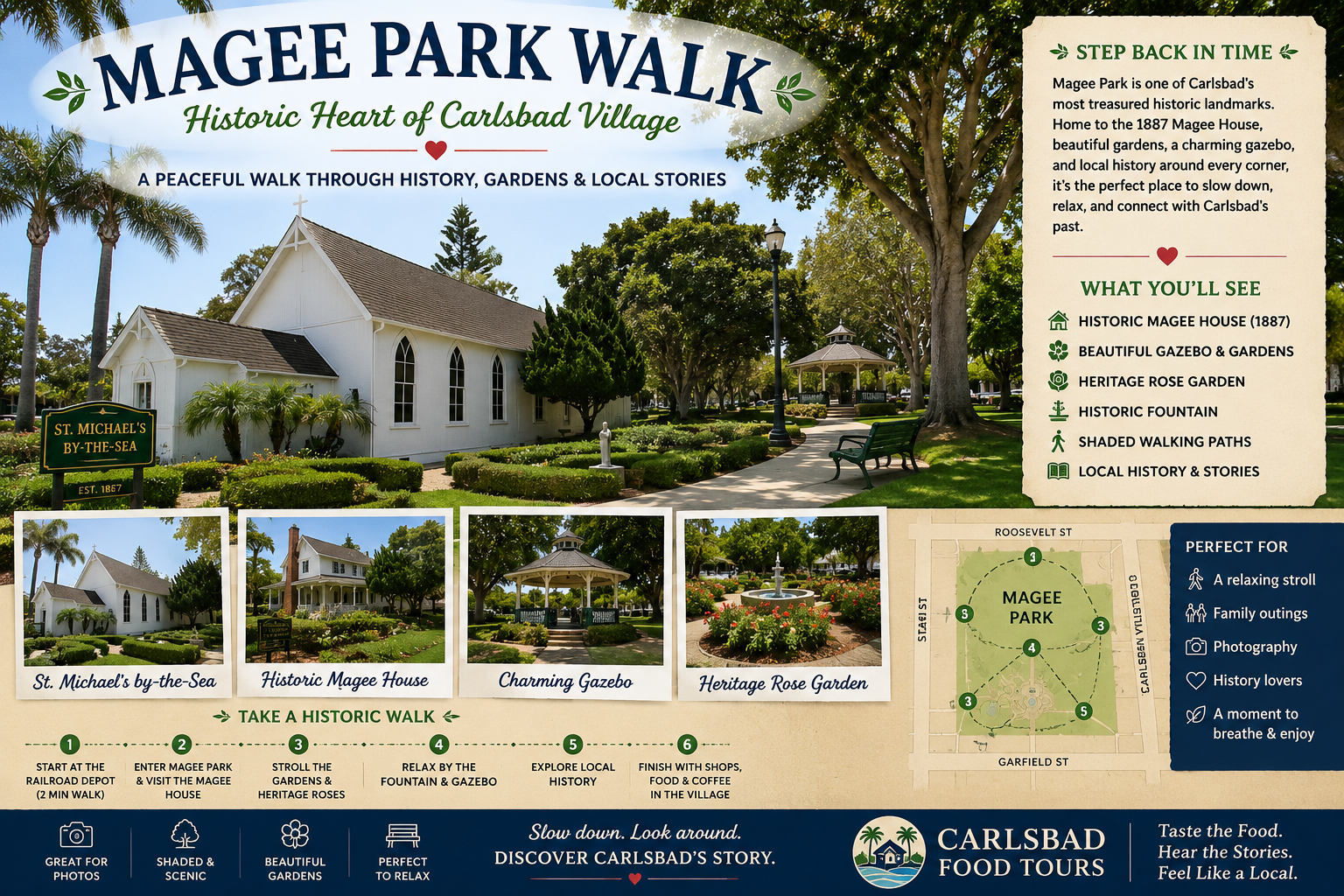
Next, walk toward Magee Park and the historic Magee House.
This is where the architectural walk shifts from commercial Carlsbad to residential Carlsbad.
Historic homes help us imagine daily life in ways commercial buildings sometimes cannot.
Look at the proportions of the house, porch, windows, roofline, and relationship between the home and surrounding gardens.
Before subdivisions and master-planned neighborhoods spread across Carlsbad, homes like this existed within a much more rural landscape.
Today, the preserved house and park offer a peaceful window into that earlier community.
Walk Through the Barrio
For another perspective on Carlsbad’s built environment, continue into the historic Barrio neighborhood.
The architecture here tells a different kind of story.
Rather than monumental buildings, you’ll find a neighborhood shaped by homes, small businesses, family gathering places, and generations of residents.
The Barrio grew alongside Carlsbad’s agricultural economy and became home to many Mexican and Mexican-American families who contributed significantly to the development of the community.
Places such as Lola’s 7-Up Market & Deli demonstrate how a modest neighborhood building can become culturally significant because of the generations of people connected to it.
Architecture isn’t only about design.
Sometimes the most important question is:
What happened inside these walls?
Spanish & Mission Influences
As you continue walking, watch for another important Southern California architectural influence: Spanish Colonial and Mission-inspired design.
Common features include:
- Stucco walls
- Red tile roofs
- Arched doorways
- Courtyards
- Decorative tile
- Wrought-iron details
- Wood beams
These elements became enormously popular throughout Southern California during the early 20th century and remain part of Carlsbad’s visual identity today.
You’ll see modern buildings borrowing these elements as well, showing how historic architectural traditions continue influencing new construction.
Mid-Century Carlsbad
Not everything worth noticing is Victorian or Spanish.
Carlsbad’s architecture continued evolving after World War II as Southern California experienced tremendous growth.
Look for older one-story commercial buildings, simple geometric storefronts, broad windows, low rooflines, and other elements associated with mid-century development.
These structures represent the period when Carlsbad was transitioning from a small agricultural town into a growing Southern California coastal city.
Some may not look “historic” at first glance, but they represent another important chapter in the city’s evolution.
Today’s Coastal Architecture
Now compare those older buildings with the newest developments in Carlsbad Village.
Modern architecture often emphasizes:
- Large windows
- Indoor-outdoor living
- Rooftop spaces
- Natural materials
- Ocean-inspired colors
- Open-air dining
- Contemporary lines
Restaurants, hotels, apartments, and mixed-use developments reflect how people want to experience Carlsbad today.
The contrast between old and new is part of what makes an architecture walk so interesting.
Within a few blocks, you can see more than a century of changing ideas about how people should live, work, dine, and gather.
Don’t Forget the Details
Some of my favorite discoveries aren’t entire buildings.
They’re details.
As you walk, look for old signs, original windows, decorative cornices, wooden porches, tile work, unusual rooflines, vintage doors, historic plaques, old brickwork, and architectural elements incorporated into newer buildings.
Sometimes one small detail is the clue that reveals a building’s earlier life.
Cherimarie’s Local Perspective
One of the things I’ve learned from telling Carlsbad’s stories is that you begin to see the Village differently once you know what you’re looking at.
You stop seeing just another building.
You see the railroad passengers arriving at the depot.
You imagine guests sitting down for one of the famous chicken dinners at the Twin Inns.
You picture residents visiting the grocery store, doctor, or newspaper office in the Killian Building.
You think about families gathering at St. Michael’s or sitting on porches in the Barrio.
The buildings become characters in Carlsbad’s story.
That’s why I love an architecture walk. It turns an ordinary stroll through downtown into a journey through time.
Create Your Own Architecture Scavenger Hunt
This can also be a fun activity for families. As you explore, see who can be the first to find:
- A red tile roof
- A Victorian detail
- An arched doorway
- A historic plaque
- An old wooden window
- Decorative tile
- A building more than 100 years old
- A mid-century storefront
- A modern rooftop patio
- A building that has been given an entirely new purpose
It’s a simple way to encourage children—and adults—to really notice their surroundings.
Seat at the Table
Carlsbad’s architecture is more than a collection of attractive buildings.
It’s a physical timeline of our community.
The depot represents transportation and opportunity. Historic homes tell stories of early families. Commercial buildings reveal how residents worked and shopped. Churches speak to community life. The Barrio reflects generations of family and cultural heritage. New buildings show how Carlsbad continues to evolve.
Preserving these places—and the stories connected to them—allows future generations to understand where Carlsbad came from.
The next time you’re walking through Carlsbad Village, slow down.
Look up. Look closely. And let the buildings tell you their stories.
Explore Carlsbad Through Food & History
Architecture is also an important part of the story we share through Carlsbad Food Tours. As we walk between tasting stops, we’re not simply traveling from restaurant to restaurant—we’re moving through more than a century of Carlsbad history.
The food introduces you to Carlsbad today.
The buildings help you understand how we got here.
Taste the Food. Hear the Stories. Feel Like a Local.