
Wildflower Guide to Carlsbad: Where Coastal California Comes Into Bloom
Discover Carlsbad’s Wild Side
Carlsbad is famous for the spectacular cultivated ranunculus at The Flower Fields, but spring color isn’t limited to those carefully planted rows.
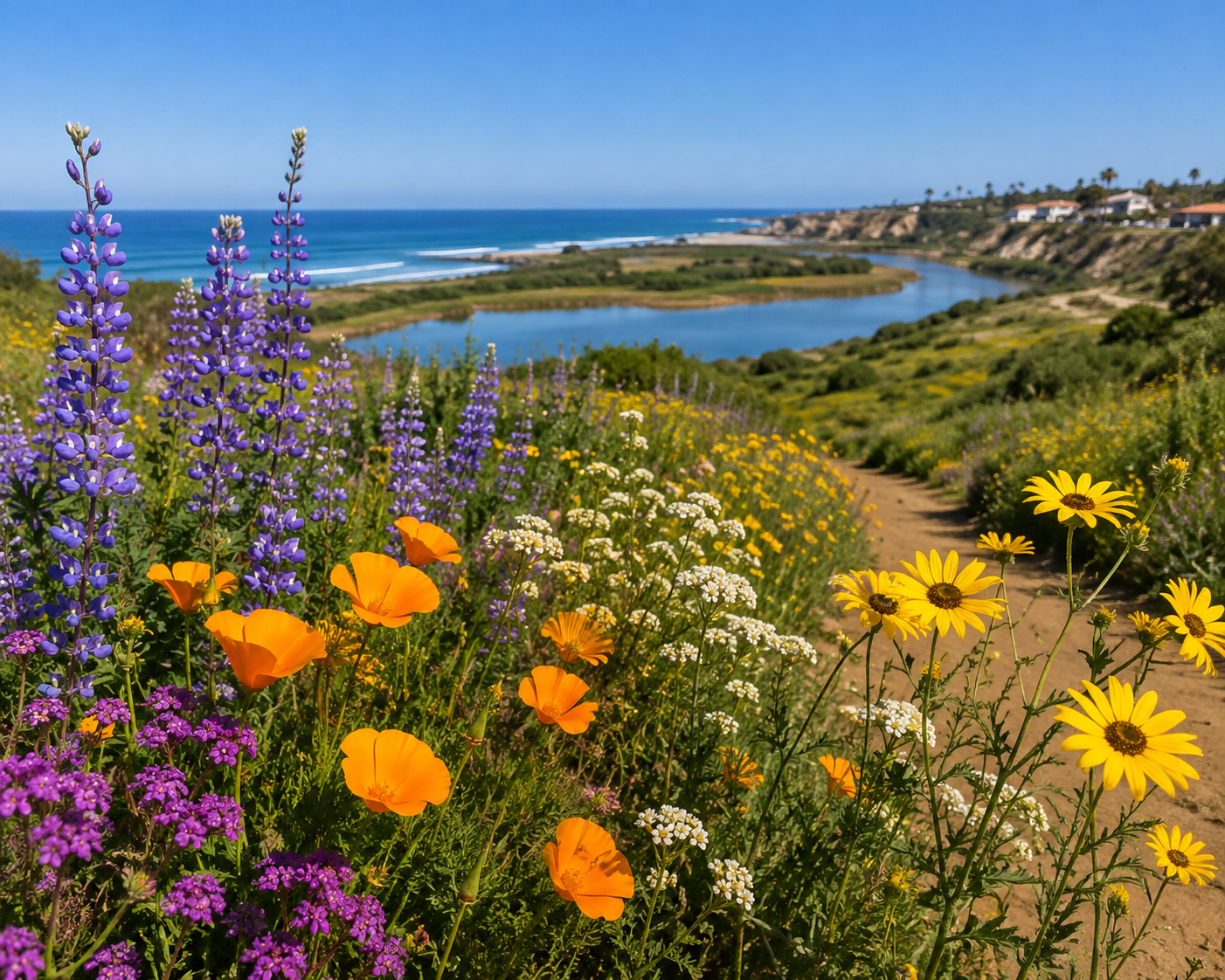
Look along our lagoon trails, coastal bluffs, open spaces, and natural areas and you’ll discover another kind of flower show—Carlsbad’s wildflowers.
After winter rains, native and naturalized flowers begin appearing across the landscape. Tiny blossoms line walking trails, yellow and orange flowers brighten hillsides, and coastal plants bloom against a backdrop of blue lagoons and the Pacific Ocean.
Unlike a formal garden, you never know exactly what you’ll find.
That’s part of the fun.
When Is Wildflower Season in Carlsbad?
Carlsbad’s wildflower season generally begins during the late winter and spring, with the timing and abundance depending heavily on rainfall, temperature, and local conditions.
A typical season may begin showing color in February, with more flowers appearing during March, April, and into May.
After a particularly wet winter, the display can be spectacular. During drier years, flowers may be more subtle—but that simply makes discovering them feel more special.
Early morning is one of my favorite times to look for wildflowers. Temperatures are cooler, trails are quieter, and the soft morning light is beautiful for photography.
Batiquitos Lagoon
Batiquitos Lagoon Foundation is one of my favorite places to experience Carlsbad’s natural landscape.
The relatively easy trail follows the lagoon and passes through coastal habitat where seasonal wildflowers and flowering native plants can appear.
Depending on the season and conditions, keep an eye out for splashes of yellow, purple, white, and orange among the coastal vegetation.
But don’t spend the entire walk looking down.
Batiquitos is also an important habitat for birds and other wildlife, so wildflower hunting often turns into birdwatching too.
This is especially personal for me because Batiquitos is one of my favorite places for a morning walk. No two walks are exactly the same. The flowers, birds, water, and light continually change with the seasons.
Agua Hedionda Lagoon
Another wonderful place to explore is the area surrounding Agua Hedionda Lagoon Foundation.
The lagoon’s varied habitats support numerous plants and animals, making it an interesting destination throughout the year.
During spring, flowering plants add color to the surrounding landscape.
Stop by the Discovery Center to learn more about the lagoon ecosystem before exploring. Understanding what you’re looking at makes a nature walk even more interesting.
Calavera Preserve
For a very different Carlsbad landscape, head inland to the Calavera Preserve.
Trails here travel through open space, hillsides, grasslands, and areas of coastal sage scrub. Following good winter rains, spring can bring patches of wildflowers throughout the preserve.
This is one of the best places in Carlsbad to combine wildflowers with hiking.
The landscape feels completely different from the beach and Village, yet you’re still in Carlsbad.
That’s something I love about our city—you can go from oceanfront walking to a surprisingly wild inland landscape in a matter of minutes.
Coastal Bluffs & Trails
Don’t overlook Carlsbad’s coastline.
Wildflowers and flowering coastal plants can appear along bluffs, trails, and less-developed stretches near the ocean.
These plants have to survive difficult conditions—wind, salt spray, sandy soils, and limited water.
That makes their spring flowers even more impressive.
The combination of wildflowers, coastal vegetation, and the Pacific Ocean also creates some of the prettiest photographs of spring in Carlsbad.
Wildflowers You May See
Exactly what you’ll encounter changes from place to place and year to year, but spring walks around coastal North County may reveal flowers and flowering plants such as:
California Poppy — California’s state flower and one of the easiest wildflowers to recognize, with brilliant orange blossoms.
Lupine — Beautiful spikes of blue, purple, or violet flowers that can add dramatic color to hillsides and trails.
California Bush Sunflower — Cheerful yellow flowers commonly associated with Southern California’s coastal sage scrub.
California Buckwheat — Clusters of delicate flowers that are also valuable to butterflies, bees, and other pollinators.
Monkeyflower — A colorful native that can produce yellow, orange, or reddish blossoms.
Blue-Eyed Grass — Despite its name, this delicate purple-blue flower is related to irises rather than grasses.
Wild Radish — A naturalized plant commonly seen along roadsides and disturbed areas, producing white, pink, lavender, and purple flowers.
Deerweed — A native shrub with small yellow flowers that provides habitat and food for wildlife.
California Sagebrush — Its flowers aren’t as showy as a poppy or lupine, but this aromatic native is an important part of our coastal sage scrub habitat.
Native Flowers vs. The Flower Fields
Visitors sometimes associate every colorful Carlsbad hillside with The Flower Fields at Carlsbad Ranch, but there is an important difference.
The spectacular Giant Tecolote Ranunculus at The Flower Fields are cultivated agricultural flowers.
Wildflowers grow naturally or have become naturalized within our local landscape.
Both are beautiful, and both tell part of Carlsbad’s story.
The Flower Fields connect us with our agricultural heritage, while native wildflowers connect us with the natural ecosystems that existed long before modern Carlsbad.
Together, they make spring one of the most colorful times of year to explore the city.
Wildflowers & Pollinators
Flowers aren’t here just for us to admire.
They’re part of a much larger ecosystem.
Bees, butterflies, moths, hummingbirds, and other animals rely on flowering plants for food. Native plants can also provide shelter and habitat for insects, birds, reptiles, and small mammals.
When you stop to photograph a flower, watch it for a moment.
You may discover a bee gathering pollen, a butterfly feeding on nectar, or a hummingbird darting between blossoms.
Suddenly you’re observing an entire little ecosystem rather than just one pretty flower.
A Wildflower Photography Walk
You don’t need professional equipment to photograph Carlsbad’s wildflowers.
Morning and late afternoon usually provide softer light than the middle of the day. Get down closer to flower level rather than always photographing from above.
Try including some of the surrounding landscape.
A close-up of a poppy is beautiful.
But a photograph showing wildflowers beside a lagoon, beneath a Carlsbad hillside, or with the Pacific in the distance tells more of the story.
And please stay on established trails rather than stepping into vegetation to get the perfect picture.
Look, Photograph—But Don’t Pick
One of the simplest ways we can protect Carlsbad’s wildflowers is to leave them where they grow.
Enjoy them.
Photograph them.
Teach your children their names.
But resist picking them or walking through patches of flowers.
A single person stepping off a trail may seem insignificant, but popular natural areas receive many visitors. Repeated trampling can damage plants and habitat.
The best souvenir is a photograph.
Cherimarie’s Local Perspective
Spring is one of my favorite times of year in Carlsbad because the entire city seems to wake up.
Everyone knows about The Flower Fields—and they’re absolutely spectacular—but I also love the smaller displays that you discover unexpectedly.
You might be walking at Batiquitos Lagoon and notice tiny purple flowers beside the trail. You may see bright yellow blossoms covering a hillside or spot a California poppy glowing in the morning sun.
Those discoveries feel different because nobody planted them there for us to see.
They’re simply part of Carlsbad being Carlsbad.
And sometimes the smallest flower along a quiet trail can be every bit as beautiful as an entire field of ranunculus.
Create a Carlsbad Spring Flower Day
For flower lovers, I’d turn this into a full Carlsbad spring experience.
Start early with a nature walk at Batiquitos Lagoon while the trails are quiet.
Then visit The Flower Fields to experience the spectacular cultivated ranunculus.
Stop for lunch in Carlsbad Village.
In the afternoon, explore Agua Hedionda Lagoon or Calavera Preserve, depending on how much walking you’d like to do.
Finish at the coast for sunset.
In one day, you’ll experience cultivated flowers, native plants, wetlands, wildlife, coastal scenery, and Carlsbad’s agricultural heritage.
Seat at the Table
Carlsbad’s wildflowers remind us that some of our city’s most beautiful attractions don’t require tickets, signs, or carefully planned gardens.
Sometimes nature creates the show.
A rainy winter passes.
The days become warmer.
A tiny green plant emerges beside a trail.
Then one morning, there’s a flower.
And before long, spring has quietly painted Carlsbad again.
So slow down on your next walk.
Look beside the trail.
Watch the hillsides.
Notice what’s blooming.
You might discover an entirely different side of Carlsbad—one wildflower at a time.
Explore More of Natural Carlsbad
This Wildflower Guide fits perfectly with the Batiquitos Lagoon, Agua Hedionda Lagoon, Calavera Hills, Wildlife Guide, Hiking Guide, Photography Guide, Flower Fields, Agricultural Heritage Tour, Favorite Morning Walks, and Spring in Carlsbad stories in the Discover Carlsbad Library.
Together, they help tell a bigger story: Carlsbad isn’t only a beach and culinary destination. It’s a place where nature, agriculture, history, and community all meet.