Agricultural Heritage Tour of Carlsbad: From Bean Fields to Flowers & Strawberries
Before Carlsbad Was a Beach Destination
Before LEGOLAND, luxury resorts, golf courses, restaurants, and master-planned neighborhoods, much of Carlsbad was farmland.
Fields stretched across hillsides that are covered with homes today. Families grew beans, flowers, strawberries, avocados, citrus, and other crops in Carlsbad’s mild coastal climate. Generations of farmers, farmworkers, and agricultural families helped create the community long before tourism became one of the city’s defining industries.
An Agricultural Heritage Tour of Carlsbad connects these stories and helps us understand an important truth about our city:
Carlsbad wasn’t built only beside the ocean. It grew from the soil.
Stop 1: The Bean Fields — Carlsbad’s Early Agricultural Landscape
It’s difficult to imagine today, but large portions of early Carlsbad were once covered in bean fields.
Beans were well suited to Southern California’s climate and became one of the crops associated with the region’s early agricultural economy.
Picture Carlsbad before Interstate 5, shopping centers, and subdivisions—open fields stretching toward the coast, dirt roads crossing farmland, and families working according to planting and harvest seasons.
Those early fields established an agricultural tradition that would continue through several generations and many different crops.
Stop 2: Avocado Groves — The Hillsides Turn Green
As agriculture evolved, avocado groves became another familiar part of Carlsbad’s landscape.
The city’s rolling hills, temperate climate, and relatively frost-free conditions made North County particularly attractive for avocado production.
For decades, groves were part of everyday Carlsbad scenery.
As residential development expanded, many disappeared, but the avocado remains a wonderful reminder of the period when agriculture covered far more of the city’s hillsides.
Even today, mature avocado and citrus trees around older properties sometimes offer little clues to Carlsbad’s agricultural past.
Stop 3: The Flower Fields — Carlsbad’s Most Colorful Agricultural Legacy
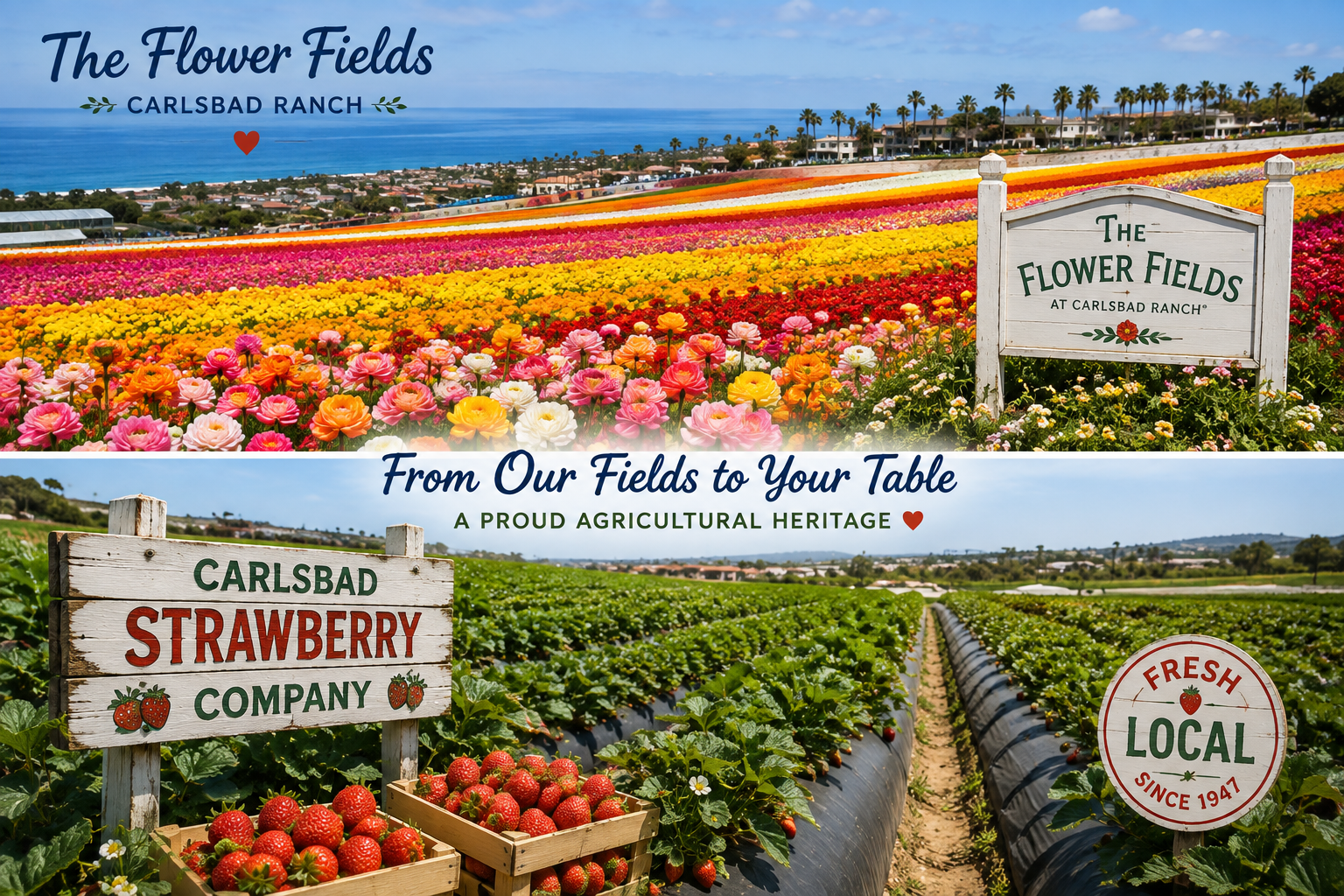
No agricultural tour of Carlsbad would be complete without The Flower Fields at Carlsbad Ranch.
Every spring, acres of Giant Tecolote Ranunculus create spectacular ribbons of red, yellow, orange, pink, purple, and white across the hillside overlooking the Pacific.
Today, The Flower Fields are one of Carlsbad’s best-known seasonal attractions, but behind those beautiful photographs is a genuine agricultural story.
Flower growing became an important part of Carlsbad’s identity, with growers including the Frazee family and later Mellano & Company helping preserve and develop the tradition.
The fields remind us that agriculture doesn’t always mean food.
Sometimes the crop is beauty.
Edwin Frazee & the Ranunculus
The story of Carlsbad’s flowers is closely associated with Edwin Frazee, whose work with ranunculus helped develop the extraordinary range of colors visitors see today.
Through careful selection over generations of plants, growers encouraged desirable colors and characteristics.
What began as agricultural work eventually produced one of the most recognizable landscapes in Carlsbad.
That’s something I love about The Flower Fields.
Visitors may initially come for a beautiful photograph, but they’re actually standing in the middle of a living piece of Carlsbad agricultural history.
Stop 4: The Strawberry Fields — A Tradition You Can Taste
Another beloved part of Carlsbad’s agricultural identity is the strawberry.
Carlsbad Strawberry Company continues the tradition along Cannon Road, where the sight of strawberries growing beside modern Carlsbad creates a wonderful contrast between the city’s past and present.
For many families, stopping for strawberries has become a Carlsbad tradition.
Depending on the season and current operations, visitors may have opportunities to experience the farm beyond simply purchasing berries.
There’s something special about seeing food growing where you live.
Children who normally encounter strawberries inside a plastic container at the grocery store suddenly understand:
This came from a field. Someone grew it. Someone harvested it.
That’s agricultural education in its simplest form.
The Ukegawa Family Story
The strawberry fields also give us an opportunity to tell the story of the Ukegawa family.
Their history represents something larger than one farm. It reflects the perseverance of agricultural families and the complicated relationship between farming, land values, development, and preservation in coastal Southern California.
As Carlsbad became increasingly desirable, agricultural land became extraordinarily valuable.
Farmers faced decisions that earlier generations could never have imagined.
Continue farming?
Sell?
Develop?
Preserve open space?
Find ways for agriculture and development to coexist?
Those questions remain part of Carlsbad’s story today.
Stop 5: The Barrio — The People Behind the Fields
To understand Carlsbad agriculture, we also need to talk about the people who did the work.
The historic Barrio became home to many Mexican and Mexican-American families whose labor and lives were deeply connected with Carlsbad’s agricultural economy.
Men and women worked in fields, nurseries, and related businesses while raising families and building a neighborhood of their own.
The Barrio became a place of family, culture, food, faith, and community.
One of its enduring landmarks is Lola’s 7-Up Market & Deli, whose family story connects beautifully with the broader history of the neighborhood.
Agricultural history isn’t simply the history of landowners and crops.
It’s also the history of the people whose hands worked the soil.
Stop 6: Magee Park — Gardens, History & Early Carlsbad
Back in Carlsbad Village, Magee Park provides another opportunity to connect residential life with the city’s agricultural past.
The historic property and gardens help visitors imagine a Carlsbad where homes existed alongside orchards, gardens, farms, and undeveloped land.
This is also a good place to talk about how families used their land differently in earlier generations.
Gardens weren’t simply decorative.
Fruit trees, herbs, vegetables, and other plants were part of daily household life.
From Farms to Neighborhoods
One of the most fascinating parts of this tour is comparing historic Carlsbad with the city we see today.
Places once occupied by:
Bean fields → became neighborhoods.
Avocado groves → became homes and businesses.
Open farmland → became roads, schools, shopping centers, and resorts.
Yet Carlsbad has managed to preserve several visible pieces of its agricultural identity.
The Flower Fields and strawberry fields are particularly important because they allow us to see agriculture rather than simply read about it.
Agriculture & Carlsbad’s Natural Environment
Farming also depended upon Carlsbad’s geography.
The coastal climate offered relatively mild temperatures. Lagoons and watersheds influenced the landscape. Rich soils supported different crops, while generations of growers learned which plants performed best under local conditions.
Agriculture therefore belongs alongside the stories of Agua Hedionda Lagoon, Batiquitos Lagoon, local wildlife, native plants, and Carlsbad’s coastal environment.
They’re all parts of the same landscape.
A Suggested Agricultural Heritage Route
Unlike the Historic Downtown Walk, this is best experienced as a driving or biking tour with several walking stops, because Carlsbad’s agricultural landmarks are spread across the city.
A good route would be:
Magee Park & historic Village → Barrio → former agricultural areas of Carlsbad → Carlsbad Strawberry Company → The Flower Fields at Carlsbad Ranch
You could also incorporate overlooks or historic photographs showing where bean fields and avocado groves once existed.
During spring, I would finish at The Flower Fields. There’s no better finale than standing above acres of ranunculus with the Pacific Ocean in the distance.
Make It Fun for Kids
An Agricultural Heritage Tour can also be a wonderful family activity.
Ask children to find:
- A strawberry plant
- A flower growing in a field
- An avocado tree
- A tractor
- An irrigation system
- A farm stand
- A historic farmhouse
- Something being harvested
- A fruit or vegetable they’ve never tried
- Evidence that an area was once farmland
Then finish the day with something grown locally.
Suddenly, history becomes something they can see, touch—and taste.
Cherimarie’s Local Perspective
When people think about Carlsbad, they usually picture the beach.
I do too.
But when I think about the story of Carlsbad, I also picture flowers, strawberries, avocado groves, and fields.
Agriculture is woven deeply into our community’s identity.
I especially love the contrast we still see today. You can stand beside a strawberry field and see modern Carlsbad surrounding it. You can look across brilliant rows of ranunculus toward neighborhoods, businesses, and the ocean.
Past and present exist right beside each other.
And I think it’s important that we continue telling the stories of the farmers, farmworkers, families, and businesses who made those fields possible.
Because before visitors came to Carlsbad to eat in our restaurants or vacation at our resorts, generations of people were already working this land.
Seat at the Table
Carlsbad’s agricultural heritage isn’t simply about what we grew.
It’s about who we became.
Bean fields tell the story of an early farming community.
Avocado groves remind us of the hillsides that existed before today’s neighborhoods.
The Flower Fields represent generations of agricultural innovation.
The strawberry fields connect today’s families with a living farming tradition.
And the Barrio reminds us to remember the people whose labor helped make Carlsbad agriculture possible.
Together, those stories create another side of Carlsbad—one that visitors won’t necessarily discover from the beach.
The next time you see a field of flowers or stop for strawberries, remember: you’re not simply visiting an attraction. You’re experiencing part of Carlsbad’s living history.
Explore More of Carlsbad’s Story
This Agricultural Heritage Tour fits beautifully alongside your Bean Fields, Avocado Groves, Flower Fields, Carlsbad Strawberry Company, Ukegawa Family, Barrio, Magee Park, Agua Hedionda Lagoon, and Batiquitos Lagoon stories in the Discover Carlsbad Library.
Together, they form a strong new Carlsbad Agricultural Heritage Collection within the Playbook.
- Posted in:
- Agriculture Heritage